
NGSS.MS-ESS2-6
Authored by Wayground Content
Science
6th - 8th Grade
NGSS covered


AI Actions
Add similar questions
Adjust reading levels
Convert to real-world scenario
Translate activity
More...
Content View
Student View
20 questions
Show all answers
1.
MULTIPLE CHOICE QUESTION
1 min • 1 pt
_____________ air is more dense and tends to sink
Tags
NGSS.MS-ESS2-6
2.
MULTIPLE CHOICE QUESTION
3 mins • 1 pt
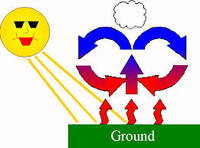
Warm air rises and the cool air sinks demonstrates this type of heat transfer.
Tags
NGSS.MS-ESS2-6
3.
MULTIPLE CHOICE QUESTION
30 sec • 1 pt

Why is the Equator warmest?
Tags
NGSS.MS-ESS2-6
4.
MULTIPLE CHOICE QUESTION
2 mins • 1 pt
What causes winds to form on Earth?
Tags
NGSS.MS-ESS2-6
5.
MULTIPLE CHOICE QUESTION
30 sec • 1 pt

Hurricanes and similar storm systems begin over oceans. The map below shows average surface temperatures of the oceans in the summer. Based on the map, which area probably produced the most violent storm systems?
Tags
NGSS.MS-ESS2-6
6.
MULTIPLE CHOICE QUESTION
30 sec • 1 pt

Ocean currents bring warm water from the equator towards Earth's
Tags
NGSS.MS-ESS2-6
7.
MULTIPLE CHOICE QUESTION
2 mins • 1 pt
The Sun heats the atmosphere of Earth unevenly. Which of the following statements is the most likely result of this uneven heating?
Convection in the atmosphere causes a change in air density, resulting in winds.
Conduction through the atmosphere causes evaporation to occur over oceans, resulting in rain.
Radiation from the Sun reflects through the atmosphere back into space resulting in cooler evenings.
Radiation from the Sun causes atmospheric moisture to collect over mountain ranges resulting in snowfall.
Tags
NGSS.MS-ESS2-6
Access all questions and much more by creating a free account
Create resources
Host any resource
Get auto-graded reports

Continue with Google

Continue with Email

Continue with Classlink

Continue with Clever
or continue with

Microsoft
%20(1).png)
Apple

Others
Already have an account?
Similar Resources on Wayground

18 questions
MIXTURE QUIZ 2

Quiz
•
5th - 6th Grade
15 questions
Nutrition in living organisms plants
Quiz
•
7th Grade
15 questions
Biological Levels of organization
Quiz
•
7th Grade
15 questions
Y9 chemistry quiz on air and water
Quiz
•
7th - 10th Grade
15 questions
Science 8 Q1 M4: Effect of Temperature to the Speed of Sound
Quiz
•
8th Grade
20 questions
Food Groups
Quiz
•
4th - 7th Grade
20 questions
WAYS TO SEPARATE MIXTURES-GAME-RECITATION
Quiz
•
6th Grade
21 questions
9.1 Quiz: rotation and revolution
Quiz
•
8th - 11th Grade
Popular Resources on Wayground
7 questions
History of Valentine's Day

Interactive video
•
4th Grade
15 questions
Fractions on a Number Line
Quiz
•
3rd Grade
20 questions
Equivalent Fractions
Quiz
•
3rd Grade
25 questions
Multiplication Facts
Quiz
•
5th Grade
22 questions
fractions
Quiz
•
3rd Grade
15 questions
Valentine's Day Trivia
Quiz
•
3rd Grade
20 questions
Main Idea and Details
Quiz
•
5th Grade
20 questions
Context Clues
Quiz
•
6th Grade
Discover more resources for Science
11 questions
Valentines Day
Quiz
•
6th - 8th Grade
25 questions
Valentine's Day Trivia
Quiz
•
8th Grade
20 questions
Cell Organelles and Functions
Quiz
•
6th - 8th Grade
20 questions
Rocks and The Rock Cycle
Quiz
•
6th Grade
8 questions
Newton's Second Law

Lesson
•
6th - 8th Grade
20 questions
Thermal Energy - Heat Transfer
Quiz
•
6th Grade
10 questions
Exploring the Rock Cycle: Types and Formation
Interactive video
•
6th - 8th Grade
10 questions
Carbon Cycle
Lesson
•
6th - 8th Grade