
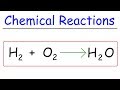
Exploring Types of Chemical Reactions

Interactive Video
•
Science
•
6th - 10th Grade
•
Practice Problem
•
Medium
Standards-aligned

Aiden Montgomery
Used 9+ times
FREE Resource
Standards-aligned
Read more
10 questions
Show all answers
1.
MULTIPLE CHOICE QUESTION
30 sec • 1 pt
What is the general formula for a synthesis reaction?
A + B → AB
AB → A + B
AB + CD → AD + CB
C + D → CD
2.
MULTIPLE CHOICE QUESTION
30 sec • 1 pt
Which of the following is an example of a synthesis reaction?
Zinc metal reacting with oxygen gas to form zinc oxide
Calcium carbonate decomposing into calcium oxide and carbon dioxide
Propane reacting with oxygen gas to produce carbon dioxide and water
Sodium chloride reacting with silver nitrate to form silver chloride and sodium nitrate
3.
MULTIPLE CHOICE QUESTION
30 sec • 1 pt
What is the reverse of a synthesis reaction?
Decomposition reaction
Double replacement reaction
Combustion reaction
Single replacement reaction
4.
MULTIPLE CHOICE QUESTION
30 sec • 1 pt
Which of the following is a decomposition reaction?
Calcium chloride reacting with sodium nitrate to produce calcium nitrate and sodium chloride
Magnesium nitride decomposing into magnesium and nitrogen gas
Ethanol reacting with oxygen gas to produce carbon dioxide and water
Zinc metal reacting with copper chloride to produce zinc chloride and copper metal
5.
MULTIPLE CHOICE QUESTION
30 sec • 1 pt
What are the typical products of a combustion reaction?
Sodium chloride and water
Calcium oxide and carbon dioxide
Carbon dioxide and water
Oxygen and hydrogen
6.
MULTIPLE CHOICE QUESTION
30 sec • 1 pt
Which of the following is an example of a combustion reaction?
Magnesium nitride decomposing into magnesium and nitrogen gas
Propane reacting with oxygen gas to produce carbon dioxide and water
Calcium chloride reacting with sodium nitrate to produce calcium nitrate and sodium chloride
Zinc metal reacting with copper chloride to produce zinc chloride and copper metal
Tags
NGSS.HS-PS1-4
7.
MULTIPLE CHOICE QUESTION
30 sec • 1 pt
In a single replacement reaction, what happens to the element A in the general formula A + BC → AC + B?
A replaces B in the compound
A combines with B to form a new compound
A decomposes into B and C
A remains unchanged
Access all questions and much more by creating a free account
Create resources
Host any resource
Get auto-graded reports

Continue with Google

Continue with Email

Continue with Classlink

Continue with Clever
or continue with

Microsoft
%20(1).png)
Apple

Others
Already have an account?


