
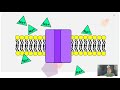
Membrane Transport Mechanisms in AP Biology

Interactive Video
•
Biology
•
6th - 10th Grade
•
Practice Problem
•
Hard

Lucas Foster
FREE Resource
Read more
10 questions
Show all answers
1.
MULTIPLE CHOICE QUESTION
30 sec • 1 pt
What are the two main types of membrane transport discussed in the video?
Passive and active transport
Endocytosis and exocytosis
Facilitated and simple diffusion
Osmosis and diffusion
2.
MULTIPLE CHOICE QUESTION
30 sec • 1 pt
Which type of molecules can passively cross the phospholipid bilayer?
Ions
Large molecules
Polar molecules
Nonpolar molecules
3.
MULTIPLE CHOICE QUESTION
30 sec • 1 pt
What is the main driving force behind simple diffusion?
Protein channels
Concentration gradient
Random collisions of molecules
ATP consumption
4.
MULTIPLE CHOICE QUESTION
30 sec • 1 pt
Which of the following is an example of facilitated diffusion?
Water moving through aquaporins
Glucose entering a cell through a protein channel
Carbon dioxide leaving a cell
Oxygen entering a cell
5.
MULTIPLE CHOICE QUESTION
30 sec • 1 pt
What is the role of protein channels in facilitated diffusion?
They help nonpolar molecules cross the membrane
They create a concentration gradient
They use ATP to move molecules
They assist ions and large molecules in crossing the membrane
6.
MULTIPLE CHOICE QUESTION
30 sec • 1 pt
What triggers the opening of voltage-gated ion channels in neurons?
Presence of specific ions
Concentration gradient
Change in membrane potential
ATP binding
7.
MULTIPLE CHOICE QUESTION
30 sec • 1 pt
During an action potential, which ions flow into the neuron first?
Sodium ions
Chloride ions
Potassium ions
Calcium ions
Access all questions and much more by creating a free account
Create resources
Host any resource
Get auto-graded reports

Continue with Google

Continue with Email

Continue with Classlink

Continue with Clever
or continue with

Microsoft
%20(1).png)
Apple

Others
Already have an account?

