
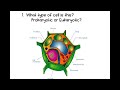
Prokaryotic vs Eukaryotic Cells: Key Concepts Review

Interactive Video
•
Science
•
6th - 8th Grade
•
Practice Problem
•
Medium
Standards-aligned

Sophia Harris
Used 22+ times
FREE Resource
Standards-aligned
Read more
10 questions
Show all answers
1.
MULTIPLE CHOICE QUESTION
30 sec • 1 pt
What does it mean when an organelle is described as 'membrane-bound'?
It has its own distinct membrane.
It lacks a protective layer.
It can freely float within the cell.
It is outside the cell.
Tags
NGSS.MS-LS1-2
2.
MULTIPLE CHOICE QUESTION
30 sec • 1 pt
Which type of cell is always a bacterium?
Eukaryotic cell
Animal cell
Prokaryotic cell
Plant cell
3.
MULTIPLE CHOICE QUESTION
30 sec • 1 pt
What is a key feature of eukaryotic cells?
They have membrane-bound organelles.
They are all single-celled.
They cannot adapt to harsh environments.
They lack a nucleus.
4.
MULTIPLE CHOICE QUESTION
30 sec • 1 pt
Which environment can prokaryotic cells adapt to?
Only mild temperatures
Nutrient-rich settings only
Extreme salt concentrations
Only oxygen-rich environments
5.
MULTIPLE CHOICE QUESTION
30 sec • 1 pt
Which type of cell is capable of living without oxygen?
Animal cells
Prokaryotic cells
Plant cells
Fungi
6.
MULTIPLE CHOICE QUESTION
30 sec • 1 pt
Which of the following is NOT a characteristic of prokaryotic cells?
Presence of a cell membrane
Lack of a true nucleus
Ability to adapt to harsh environments
Having membrane-bound organelles
7.
MULTIPLE CHOICE QUESTION
30 sec • 1 pt
Where is DNA located in eukaryotic cells?
Floating in the cytoplasm
Within the cell membrane
Outside the cell
Within the nucleus
Access all questions and much more by creating a free account
Create resources
Host any resource
Get auto-graded reports

Continue with Google

Continue with Email

Continue with Classlink

Continue with Clever
or continue with

Microsoft
%20(1).png)
Apple

Others
Already have an account?


