
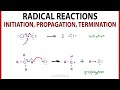
Understanding Radical Reactions

Interactive Video
•
Chemistry, Science
•
10th - 12th Grade
•
Practice Problem
•
Hard

Liam Anderson
FREE Resource
Read more
10 questions
Show all answers
1.
MULTIPLE CHOICE QUESTION
30 sec • 1 pt
What is a radical in the context of chemistry?
A molecule with paired electrons
A molecule with an unpaired electron
A stable molecule
A molecule with no electrons
2.
MULTIPLE CHOICE QUESTION
30 sec • 1 pt
Why are free radicals considered dangerous in biological systems?
They stabilize DNA
They form stable bonds with proteins
They can attack and damage cells
They are non-reactive
3.
MULTIPLE CHOICE QUESTION
30 sec • 1 pt
What is the main difference between heterolytic and homolytic cleavage?
Heterolytic cleavage results in radicals
Homolytic cleavage results in ions
Homolytic cleavage involves equal electron distribution
Heterolytic cleavage involves equal electron sharing
4.
MULTIPLE CHOICE QUESTION
30 sec • 1 pt
In a homolytic cleavage, what happens to the electrons in a bond?
They are lost completely
They form a new bond with a third atom
They are transferred to one atom
They are shared equally between atoms
5.
MULTIPLE CHOICE QUESTION
30 sec • 1 pt
What initiates the formation of radicals in the initiation step?
Adding a catalyst
Applying heat or light
Increasing pressure
Cooling the system
6.
MULTIPLE CHOICE QUESTION
30 sec • 1 pt
During the initiation step, what is the result of homolytic cleavage of Cl2?
Formation of a stable Cl2 molecule
Formation of Cl- ions
Formation of Cl+ ions
Formation of two Cl radicals
7.
MULTIPLE CHOICE QUESTION
30 sec • 1 pt
What characterizes the propagation step in radical reactions?
Radicals are destroyed
Radicals are formed and consumed
No radicals are involved
Radicals form stable compounds
Access all questions and much more by creating a free account
Create resources
Host any resource
Get auto-graded reports

Continue with Google

Continue with Email

Continue with Classlink

Continue with Clever
or continue with

Microsoft
%20(1).png)
Apple

Others
Already have an account?
Similar Resources on Wayground

6 questions
Minerals and Their Properties: Video Quiz
Interactive video
•
10th - 12th Grade
8 questions
Master how to find all of the zeros of a polynomial when given one irrational zero
Interactive video
•
11th Grade - University
8 questions
Why the Hardest Rocks Can Be Easy to Break
Interactive video
•
11th Grade - University
6 questions
Dividing two functions to determine the domain
Interactive video
•
11th Grade - University
6 questions
Learn How to Multiply Two Radical Expression and Simplify
Interactive video
•
11th Grade - University
6 questions
Mulitplying a radical expression to simplify ex 13, 5root(2x) . 3root(8x)
Interactive video
•
11th Grade - University
8 questions
Composing Twelve-Tone Music - Including the Familiar
Interactive video
•
10th - 12th Grade
11 questions
Animals Inspiring the Armor of the Future
Interactive video
•
11th Grade - University
Popular Resources on Wayground
15 questions
Fractions on a Number Line

Quiz
•
3rd Grade
20 questions
Equivalent Fractions
Quiz
•
3rd Grade
25 questions
Multiplication Facts
Quiz
•
5th Grade
29 questions
Alg. 1 Section 5.1 Coordinate Plane
Quiz
•
9th Grade
22 questions
fractions
Quiz
•
3rd Grade
11 questions
FOREST Effective communication

Lesson
•
KG
20 questions
Main Idea and Details
Quiz
•
5th Grade
20 questions
Context Clues
Quiz
•
6th Grade
Discover more resources for Chemistry
22 questions
Unit 9 Gas Law Quiz
Quiz
•
10th Grade
10 questions
Exploring Types of Chemical Reactions
Interactive video
•
6th - 10th Grade
20 questions
Types of Chemical Reactions
Quiz
•
9th - 12th Grade
20 questions
Acids and Bases
Quiz
•
10th Grade
7 questions
GCSE Chemistry - Balancing Chemical Equations #4
Interactive video
•
9th - 10th Grade
20 questions
Chemistry: Classification of Matter
Quiz
•
10th Grade
40 questions
Unit 3 (Part 1) Chemical Equations & Reactions Review Game
Quiz
•
8th - 12th Grade
20 questions
Stoichiometry Review
Quiz
•
10th Grade