
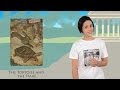
Understanding Fables and Aesop's Legacy

Interactive Video
•
English, Moral Science, History
•
4th - 8th Grade
•
Practice Problem
•
Hard

Ethan Morris
FREE Resource
Read more
8 questions
Show all answers
1.
MULTIPLE CHOICE QUESTION
30 sec • 1 pt
What is a common feature of fables?
They are always set in a forest.
They feature talking animals as main characters.
They are written in poetic form.
They always have a happy ending.
2.
MULTIPLE CHOICE QUESTION
30 sec • 1 pt
What is the moral of 'The Tortoise and the Hare'?
Actions speak louder than words.
Fast and furious wins the race.
The early bird catches the worm.
Slow and steady wins the race.
3.
MULTIPLE CHOICE QUESTION
30 sec • 1 pt
Which lesson is taught by 'The Boy Who Cried Wolf'?
Birds of a feather flock together.
Honesty is the best policy.
A stitch in time saves nine.
The pen is mightier than the sword.
4.
MULTIPLE CHOICE QUESTION
30 sec • 1 pt
What is a common source of many old sayings like 'Look before you leap'?
Shakespeare's plays
Aesop's fables
The Bible
Grimm's fairy tales
5.
MULTIPLE CHOICE QUESTION
30 sec • 1 pt
What is one theory about Aesop's life?
He was a slave who gained influence through storytelling.
He was a king who loved stories.
He was a famous warrior.
He was a renowned philosopher.
6.
MULTIPLE CHOICE QUESTION
30 sec • 1 pt
Which ancient writers mentioned Aesop?
Virgil and Ovid
Aristotle, Herodotus, and Plutarch
Homer and Hesiod
Socrates and Plato
7.
MULTIPLE CHOICE QUESTION
30 sec • 1 pt
What is a reason Aesop's fables are still relevant today?
They are only for children.
They are considered high art.
They are complex and difficult to understand.
They serve as a moral compass.
Access all questions and much more by creating a free account
Create resources
Host any resource
Get auto-graded reports

Continue with Google

Continue with Email

Continue with Classlink

Continue with Clever
or continue with

Microsoft
%20(1).png)
Apple

Others
Already have an account?

