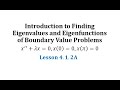
Eigenvalues and Eigenfunctions Concepts

Interactive Video
•
Mathematics, Science
•
11th Grade - University
•
Practice Problem
•
Hard

Amelia Wright
FREE Resource
Read more
10 questions
Show all answers
1.
MULTIPLE CHOICE QUESTION
30 sec • 1 pt
What is an eigenvalue in the context of boundary value problems?
A number that makes the boundary conditions equal
A number that makes the differential equation homogeneous
A number for which there exists a non-zero solution to the boundary value problem
A number that solves the characteristic equation
2.
MULTIPLE CHOICE QUESTION
30 sec • 1 pt
How are eigenvalues and eigenfunctions similar to eigenvalues and eigenvectors of matrices?
Both involve differential operators
Both involve finding non-zero solutions
Both involve matrix multiplication
Both involve solving linear equations
3.
MULTIPLE CHOICE QUESTION
30 sec • 1 pt
In the example problem, what is the general solution for X'' + Lambda X = 0 when Lambda > 0?
X = A cos(t) + B sin(t)
X = A e^(Lambda t) + B e^(-Lambda t)
X = A cos(sqrt(Lambda) t) + B sin(sqrt(Lambda) t)
X = A t + B
4.
MULTIPLE CHOICE QUESTION
30 sec • 1 pt
What condition must be met for the sine function in the example problem to have a non-zero solution?
The input must be zero
The input must be a multiple of 2pi
The input must be a multiple of pi/2
The input must be a multiple of pi
5.
MULTIPLE CHOICE QUESTION
30 sec • 1 pt
Why is Lambda = 0 not considered an eigenvalue in the example problem?
Because it results in a constant solution
Because it results in a zero solution
Because it results in a non-linear solution
Because it results in a non-zero solution
6.
MULTIPLE CHOICE QUESTION
30 sec • 1 pt
What is the form of the general solution for X'' + Lambda X = 0 when Lambda < 0?
X = A t + B
X = A cos(sqrt(Lambda) t) + B sin(sqrt(Lambda) t)
X = A e^(Lambda t) + B e^(-Lambda t)
X = A cosh(sqrt(-Lambda) t) + B sinh(sqrt(-Lambda) t)
7.
MULTIPLE CHOICE QUESTION
30 sec • 1 pt
Why are there no negative eigenvalues in the example problem?
Because the hyperbolic cosine function is zero only when the input is zero
Because the hyperbolic cosine function is always positive
Because the hyperbolic sine function is zero only when the input is zero
Because the hyperbolic sine function is always positive
Access all questions and much more by creating a free account
Create resources
Host any resource
Get auto-graded reports

Continue with Google

Continue with Email

Continue with Classlink

Continue with Clever
or continue with

Microsoft
%20(1).png)
Apple

Others
Already have an account?
Similar Resources on Wayground

6 questions
Simplifying a basic trigonometric expression
Interactive video
•
11th Grade - University
6 questions
Solve trigonometric equation by factoring with sine and cosine
Interactive video
•
11th Grade - University
6 questions
Learn how to add two polynomials with missing like terms
Interactive video
•
11th Grade - University
8 questions
Write a polynomial when given a complex and real root
Interactive video
•
11th Grade - University
8 questions
Learn to find the tangent line through the point of the function
Interactive video
•
11th Grade - University
8 questions
How do you graph a rational function with asymptotes
Interactive video
•
11th Grade - University
6 questions
Simple Harmonic Motion Introduction via a Horizontal Mass-Spring System
Interactive video
•
11th Grade - University
6 questions
Identify the vertex and max min by completing the square
Interactive video
•
11th Grade - University
Popular Resources on Wayground
8 questions
2 Step Word Problems

Quiz
•
KG - University
20 questions
Comparing Fractions
Quiz
•
4th Grade
15 questions
Fractions on a Number Line
Quiz
•
3rd Grade
20 questions
Equivalent Fractions
Quiz
•
3rd Grade
25 questions
Multiplication Facts
Quiz
•
5th Grade
10 questions
Latin Bases claus(clois,clos, clud, clus) and ped
Quiz
•
6th - 8th Grade
22 questions
fractions
Quiz
•
3rd Grade
7 questions
The Story of Books
Quiz
•
6th - 8th Grade
Discover more resources for Mathematics
8 questions
2 Step Word Problems
Quiz
•
KG - University
13 questions
Model Exponential Growth and Decay Scenarios
Quiz
•
9th - 12th Grade
15 questions
TSI Math Practice Questions
Quiz
•
8th - 12th Grade
24 questions
Identify Properties of Polygons and Quadrilaterals
Quiz
•
9th - 12th Grade
25 questions
Simplify Expressions with Exponents
Quiz
•
9th - 12th Grade
20 questions
Basic Trig Ratios
Quiz
•
9th - 12th Grade
15 questions
Exponential Growth and Decay Word Problems
Quiz
•
9th - 12th Grade
16 questions
Identify and Analyze Geometric Sequences
Quiz
•
9th - 12th Grade