
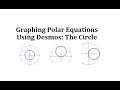
Exploring Polar Equations of Circles

Interactive Video
•
Mathematics, Computers
•
9th - 12th Grade
•
Practice Problem
•
Hard

Lucas Foster
FREE Resource
Read more
10 questions
Show all answers
1.
MULTIPLE CHOICE QUESTION
30 sec • 1 pt
What is the primary purpose of using Desmos in this lesson?
To graph quadratic functions
To understand linear equations
To learn basic arithmetic operations
To explore the equations of circles in polar form
2.
MULTIPLE CHOICE QUESTION
30 sec • 1 pt
What is the effect of changing the grid to polar form in Desmos?
It changes the color of the graph
It allows graphing in polar coordinates
It zooms in on the graph
It changes the graph to a 3D view
3.
MULTIPLE CHOICE QUESTION
30 sec • 1 pt
In the equation r = n, what does the absolute value of n represent?
The diameter of the circle
The circumference of the circle
The radius of the circle
The area of the circle
4.
MULTIPLE CHOICE QUESTION
30 sec • 1 pt
How does the circle's orientation change when n is negative in the equation r = n sin(θ)?
The circle disappears
The diameter is along the negative y-axis
The circle becomes a line
The diameter is along the positive x-axis
5.
MULTIPLE CHOICE QUESTION
30 sec • 1 pt
In the equation r = n sin(θ), what does the absolute value of n determine?
The radius of the circle
The circumference of the circle
The diameter of the circle
The area of the circle
6.
MULTIPLE CHOICE QUESTION
30 sec • 1 pt
What happens to the circle's diameter when n is positive in the equation r = n cos(θ)?
It is along the positive y-axis
It is along the negative y-axis
It is along the negative x-axis
It is along the positive x-axis
7.
MULTIPLE CHOICE QUESTION
30 sec • 1 pt
What is the result of setting n to a negative value in the equation r = n cos(θ)?
The circle's diameter is along the positive x-axis
The circle's diameter is along the positive y-axis
The circle's diameter is along the negative x-axis
The circle disappears
Access all questions and much more by creating a free account
Create resources
Host any resource
Get auto-graded reports

Continue with Google

Continue with Email

Continue with Classlink

Continue with Clever
or continue with

Microsoft
%20(1).png)
Apple

Others
Already have an account?

