
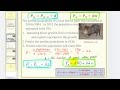
Linear Growth and Population Modeling

Interactive Video
•
Mathematics
•
7th - 10th Grade
•
Practice Problem
•
Hard
+2
Standards-aligned

Liam Anderson
FREE Resource
Standards-aligned
Read more
10 questions
Show all answers
1.
MULTIPLE CHOICE QUESTION
30 sec • 1 pt
What is the main focus of this lesson on linear growth?
Expressing linear growth in recursive and explicit forms
Exploring exponential growth
Understanding quadratic growth
Learning about logarithmic growth
Tags
CCSS.HSF.BF.A.2
2.
MULTIPLE CHOICE QUESTION
30 sec • 1 pt
In the context of linear growth, what does the explicit form P_sub_N = P_sub_0 + D x N represent?
The exponential growth formula
The slope-intercept form of a line
The quadratic equation
The logarithmic function
Tags
CCSS.HSF.BF.A.2
3.
MULTIPLE CHOICE QUESTION
30 sec • 1 pt
How is the common difference D calculated in the example of the Javelina population?
By adding the initial and final populations
By subtracting the initial year from the final year
By dividing the change in population by the change in years
By multiplying the initial population by the number of years
Tags
CCSS.HSF.BF.A.2
4.
MULTIPLE CHOICE QUESTION
30 sec • 1 pt
What does a positive common difference indicate about the population?
The population is constant
The population is decreasing
The population is increasing
The population is fluctuating
Tags
CCSS.HSF-IF.C.7E
5.
MULTIPLE CHOICE QUESTION
30 sec • 1 pt
What is the starting point for the population graph in the example?
(0, 0)
(12, 464)
(0, 200)
(8, 376)
Tags
CCSS.HSF.IF.A.3
6.
MULTIPLE CHOICE QUESTION
30 sec • 1 pt
How is the recursive formula for linear growth expressed?
P_sub_N = P_sub_N + 1 - D
P_sub_N = P_sub_0 - D x N
P_sub_N = P_sub_0 + D x N
P_sub_N = P_sub_N - 1 + D
Tags
CCSS.HSF.BF.A.2
7.
MULTIPLE CHOICE QUESTION
30 sec • 1 pt
What is the predicted Javelina population in 2016 using the explicit formula?
376
200
500
464
Tags
CCSS.HSF.LE.A.4
Access all questions and much more by creating a free account
Create resources
Host any resource
Get auto-graded reports

Continue with Google

Continue with Email

Continue with Classlink

Continue with Clever
or continue with

Microsoft
%20(1).png)
Apple

Others
Already have an account?
Popular Resources on Wayground

8 questions
Spartan Way - Classroom Responsible

Quiz
•
9th - 12th Grade
15 questions
Fractions on a Number Line
Quiz
•
3rd Grade
14 questions
Boundaries & Healthy Relationships

Lesson
•
6th - 8th Grade
20 questions
Equivalent Fractions
Quiz
•
3rd Grade
3 questions
Integrity and Your Health
Lesson
•
6th - 8th Grade
25 questions
Multiplication Facts
Quiz
•
5th Grade
9 questions
FOREST Perception
Lesson
•
KG
20 questions
Main Idea and Details
Quiz
•
5th Grade
Discover more resources for Mathematics
20 questions
Scatter Plots and Line of Best Fit
Quiz
•
8th Grade
12 questions
8th U6 L4 - Fitting a Line to Data
Quiz
•
8th Grade
14 questions
Volume of rectangular prisms
Quiz
•
7th Grade
25 questions
Scatter Plots and Line of Best Fit
Quiz
•
8th Grade
14 questions
finding slope from a graph
Quiz
•
8th Grade
20 questions
Graphing Inequalities on a Number Line
Quiz
•
6th - 9th Grade
18 questions
Identifying Radius/Diameter
Quiz
•
7th Grade
20 questions
Pythagorean Theorem Review
Quiz
•
8th Grade