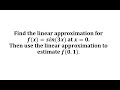
Linear Approximations and Derivatives

Interactive Video
•
Mathematics
•
9th - 12th Grade
•
Practice Problem
•
Hard
Standards-aligned

Lucas Foster
FREE Resource
Standards-aligned
Read more
10 questions
Show all answers
1.
MULTIPLE CHOICE QUESTION
30 sec • 1 pt
What is the main goal of finding a linear approximation for a function?
To estimate the function's value near a point
To find the exact value of the function at a point
To calculate the integral of the function
To determine the maximum value of the function
Tags
CCSS.HSF.TF.B.7
2.
MULTIPLE CHOICE QUESTION
30 sec • 1 pt
What is the y-coordinate of the point of tangency for f(x) = sin(3x) at x = 0?
1
sin(3)
3
0
3.
MULTIPLE CHOICE QUESTION
30 sec • 1 pt
Which mathematical rule is used to find the derivative of f(x) = sin(3x)?
Chain Rule
Quotient Rule
Product Rule
Power Rule
4.
MULTIPLE CHOICE QUESTION
30 sec • 1 pt
What is the slope of the tangent line to f(x) = sin(3x) at x = 0?
1
0
3
sin(3)
5.
MULTIPLE CHOICE QUESTION
30 sec • 1 pt
Which form is used to derive the equation of the tangent line?
Slope-intercept form
Standard form
Point-slope form
Vertex form
6.
MULTIPLE CHOICE QUESTION
30 sec • 1 pt
What is the linear approximation L(x) for f(x) = sin(3x) at x = 0?
L(x) = x
L(x) = sin(x)
L(x) = 0
L(x) = 3x
7.
MULTIPLE CHOICE QUESTION
30 sec • 1 pt
How is the linear approximation used to estimate f(0.1)?
By substituting 0.1 into the linear approximation
By finding the integral from 0 to 0.1
By calculating the exact value of f(0.1)
By using the derivative at x = 0.1
Tags
CCSS.HSF.IF.A.2
Access all questions and much more by creating a free account
Create resources
Host any resource
Get auto-graded reports

Continue with Google

Continue with Email

Continue with Classlink

Continue with Clever
or continue with

Microsoft
%20(1).png)
Apple

Others
Already have an account?
Popular Resources on Wayground

7 questions
History of Valentine's Day
Interactive video
•
4th Grade
15 questions
Fractions on a Number Line

Quiz
•
3rd Grade
20 questions
Equivalent Fractions
Quiz
•
3rd Grade
25 questions
Multiplication Facts
Quiz
•
5th Grade
22 questions
fractions
Quiz
•
3rd Grade
15 questions
Valentine's Day Trivia
Quiz
•
3rd Grade
20 questions
Main Idea and Details
Quiz
•
5th Grade
20 questions
Context Clues
Quiz
•
6th Grade
Discover more resources for Mathematics
20 questions
Graphing Inequalities on a Number Line
Quiz
•
6th - 9th Grade
20 questions
Exponent Properties
Quiz
•
9th Grade
15 questions
Combine Like Terms and Distributive Property
Quiz
•
8th - 9th Grade
20 questions
Function or Not a Function
Quiz
•
8th - 9th Grade
10 questions
Factor Quadratic Expressions with Various Coefficients
Quiz
•
9th - 12th Grade
10 questions
Elijah McCoy: Innovations and Impact in Black History
Interactive video
•
6th - 10th Grade
10 questions
Evaluating Piecewise Functions Practice
Quiz
•
11th Grade
21 questions
Factoring Trinomials (a=1)
Quiz
•
9th Grade