
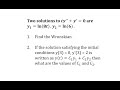
Understanding the Wronskian and Initial Conditions

Interactive Video
•
Mathematics, Science
•
10th - 12th Grade
•
Practice Problem
•
Hard

Lucas Foster
FREE Resource
Read more
10 questions
Show all answers
1.
MULTIPLE CHOICE QUESTION
30 sec • 1 pt
What is the main task described in the introduction of the problem?
Calculating the area under a curve
Solving a quadratic equation
Finding the Wronskian and solving for constants c1 and c2
Finding the roots of a polynomial
2.
MULTIPLE CHOICE QUESTION
30 sec • 1 pt
What is the first step in determining the Wronskian?
Finding the second derivative
Calculating a 2x2 determinant
Solving a linear equation
Integrating the function
3.
MULTIPLE CHOICE QUESTION
30 sec • 1 pt
What is the derivative of a constant function?
The natural logarithm of the function
The function itself
Zero
One
4.
MULTIPLE CHOICE QUESTION
30 sec • 1 pt
Why is the Wronskian important in this context?
It provides the maximum value of the function
It helps find the roots of the equation
It determines if the solutions form a fundamental set
It calculates the area under the curve
5.
MULTIPLE CHOICE QUESTION
30 sec • 1 pt
What does a non-zero Wronskian indicate about the solutions?
They are complex numbers
They are not solutions
They are linearly dependent
They form a fundamental set of solutions
6.
MULTIPLE CHOICE QUESTION
30 sec • 1 pt
What initial condition is used to find c1?
y(3) = 0
y(0) = 0
y'(0) = 2
y'(3) = 2
7.
MULTIPLE CHOICE QUESTION
30 sec • 1 pt
How is c1 determined from the initial condition?
By dividing both sides of the equation by 3
By multiplying both sides of the equation by 3
By integrating the function
By solving a quadratic equation
Access all questions and much more by creating a free account
Create resources
Host any resource
Get auto-graded reports

Continue with Google

Continue with Email

Continue with Classlink

Continue with Clever
or continue with

Microsoft
%20(1).png)
Apple

Others
Already have an account?

