
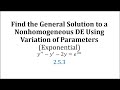
Variation of Parameters in Differential Equations

Interactive Video
•
Mathematics, Science
•
11th Grade - University
•
Practice Problem
•
Hard

Liam Anderson
FREE Resource
Read more
10 questions
Show all answers
1.
MULTIPLE CHOICE QUESTION
30 sec • 1 pt
What is the main purpose of the variation of parameters method?
To find a particular solution to a non-homogeneous differential equation
To solve linear first-order homogeneous differential equations
To determine the stability of a differential equation
To solve linear algebraic equations
2.
MULTIPLE CHOICE QUESTION
30 sec • 1 pt
Which of the following is NOT a step in the variation of parameters method?
Find the Wronskian of the solutions
Integrate to find the particular solution
Solve the corresponding homogeneous differential equation
Use Laplace transforms to find the solution
3.
MULTIPLE CHOICE QUESTION
30 sec • 1 pt
What is the characteristic equation used for in the context of differential equations?
To calculate the Wronskian
To determine the nature of the roots
To find the particular solution
To solve algebraic equations
4.
MULTIPLE CHOICE QUESTION
30 sec • 1 pt
In the example, what are the roots of the characteristic equation?
R = 1 and R = -2
R = 0 and R = 3
R = -1 and R = 1
R = 2 and R = -1
5.
MULTIPLE CHOICE QUESTION
30 sec • 1 pt
What is the Wronskian used for in the variation of parameters method?
To calculate the characteristic equation
To determine the linear independence of solutions
To find the particular solution
To solve the homogeneous equation
6.
MULTIPLE CHOICE QUESTION
30 sec • 1 pt
Which function is used in the integration process to find the particular solution?
The characteristic equation
The Wronskian
The complementary function
The original non-homogeneous function
7.
MULTIPLE CHOICE QUESTION
30 sec • 1 pt
What is the final form of the general solution in the example?
Y(x) = C1 * e^(2x) + C2 * e^(-x) + 1/4 * e^(3x)
Y(x) = C1 * e^(x) + C2 * e^(-2x) + 1/3 * e^(3x)
Y(x) = C1 * e^(2x) + C2 * e^(x) + 1/3 * e^(3x)
Y(x) = C1 * e^(3x) + C2 * e^(x) + 1/4 * e^(2x)
Access all questions and much more by creating a free account
Create resources
Host any resource
Get auto-graded reports

Continue with Google

Continue with Email

Continue with Classlink

Continue with Clever
or continue with

Microsoft
%20(1).png)
Apple

Others
Already have an account?

