
Algebra 1: Topic 3 (Linear Functions)
Authored by Jeannie Bui
English, Mathematics
9th - 12th Grade
CCSS covered
Used 7+ times


AI Actions
Add similar questions
Adjust reading levels
Convert to real-world scenario
Translate activity
More...
Content View
Student View
62 questions
Show all answers
1.
MULTIPLE CHOICE QUESTION
1 min • 1 pt
1. Let 𝐹 be a set of ordered pairs such that {(−3,5),(3,0),(2,2)}. Which of the following statements about the relation is true?
The relation is a function because no value in the domain goes to multiple values in the range.
The relation is a function because all values in the range are different.
The relation is not a function because one value in the domain goes to multiple values in the range.
The relation is not a function because there is an ordered pair where the domain is equal to the range.
Tags
CCSS.8.F.A.1
2.
MULTIPLE CHOICE QUESTION
30 sec • 1 pt

Which choice also represents the relation shown in the sets below as correct ordered pairs?
{(1,2),(2,4)}
{(2,1),(4,2),(6,2)}
{(1,2),(2,4),(2,6)}
{(2,2),(2,4),(2,6)}
Tags
CCSS.8.F.A.1
CCSS.HSF.IF.A.1
3.
MULTIPLE CHOICE QUESTION
1 min • 1 pt

Is the relation above a function?
Yes, because it doesn’t show any repeating 𝑥 values in the domain.
Yes, because every 𝑦 value in the range is different.
No, because one 𝑥 value in the domain goes to multiple different 𝑦 values in the range.
No, because there is an 𝑥 value in the domain that is equal to a 𝑦 value in the range.
Tags
CCSS.8.F.A.1
4.
MULTIPLE CHOICE QUESTION
1 min • 1 pt
If 𝑓(𝑥)=2𝑥+4, which of the following domain values would cause 𝑓(𝑥)=10?
x = 10
x = 3
x = 6
x =5
Tags
CCSS.8.F.A.1
CCSS.HSF.IF.A.1
5.
MULTIPLE CHOICE QUESTION
1 min • 1 pt
Let 𝑓(𝑥)=𝑥−7. Find the value of 𝑓(2).
5
-7
7
-5
Tags
CCSS.HSF.IF.A.2
6.
MULTIPLE CHOICE QUESTION
1 min • 1 pt

Is this set of ordered pairs a function or not a function?
Tags
CCSS.8.F.A.1
7.
MULTIPLE CHOICE QUESTION
1 min • 1 pt
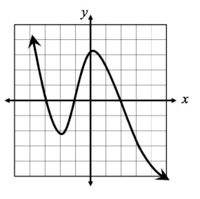
Is this graph a function or not a function?


Access all questions and much more by creating a free account
Create resources
Host any resource
Get auto-graded reports

Continue with Google

Continue with Email

Continue with Classlink

Continue with Clever
or continue with

Microsoft
%20(1).png)
Apple

Others
Already have an account?
Similar Resources on Wayground

60 questions
Quiz Kelas 9

Quiz
•
9th Grade
60 questions
PRACTICE UNIT 7 G12 - AI
Quiz
•
12th Grade
62 questions
Advanced WWW List 1
Quiz
•
6th Grade - University
65 questions
Pre Test ALGEBRA
Quiz
•
9th - 12th Grade
60 questions
1º ESO 3rd term
Quiz
•
9th Grade
66 questions
ASESMEN MADRASAH MTS AL ISLAM GENILANGIT 2023/2024 MAPEL B.ING
Quiz
•
9th Grade
60 questions
3RD SUMMATIVE TEST IN STATISTICS AND PROBABILITY
Quiz
•
12th Grade
62 questions
7.4 Logarithmic Functions with Base 10 and Base e
Quiz
•
12th Grade
Popular Resources on Wayground
7 questions
History of Valentine's Day

Interactive video
•
4th Grade
15 questions
Fractions on a Number Line
Quiz
•
3rd Grade
20 questions
Equivalent Fractions
Quiz
•
3rd Grade
25 questions
Multiplication Facts
Quiz
•
5th Grade
22 questions
fractions
Quiz
•
3rd Grade
15 questions
Valentine's Day Trivia
Quiz
•
3rd Grade
20 questions
Main Idea and Details
Quiz
•
5th Grade
20 questions
Context Clues
Quiz
•
6th Grade
Discover more resources for English
10 questions
Exploring Valentine's Day with Charlie Brown
Interactive video
•
6th - 10th Grade
10 questions
Verb Tense Consistency Formative Assessment
Quiz
•
5th - 9th Grade
20 questions
Figurative Language Review
Quiz
•
10th Grade
18 questions
Success Strategies
Quiz
•
9th - 12th Grade
10 questions
Exploring Nonfiction Text Features
Interactive video
•
6th - 10th Grade
16 questions
ACT English - Grammar Practice #2
Quiz
•
11th Grade
10 questions
Valentine's Day Trivia
Quiz
•
9th - 12th Grade
16 questions
Ethos, Pathos, Logos Practice
Quiz
•
9th Grade