
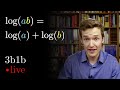
Understanding Logarithms and Exponential Growth

Interactive Video
•
Mathematics, Science
•
10th Grade - University
•
Practice Problem
•
Hard

Aiden Montgomery
FREE Resource
Read more
10 questions
Show all answers
1.
MULTIPLE CHOICE QUESTION
30 sec • 1 pt
What is the primary advantage of using a logarithmic scale when analyzing data that grows exponentially?
It simplifies the data by reducing the number of data points.
It makes it easier to see trends and patterns in multiplicative growth.
It converts all data into a linear format.
It eliminates the need for complex calculations.
2.
MULTIPLE CHOICE QUESTION
30 sec • 1 pt
Which of the following is a correct statement about the inverse of exponentiation?
The inverse of exponentiation is always logarithms.
The inverse of exponentiation is always nth rooting.
The inverse of exponentiation can be either nth rooting or logarithms.
The inverse of exponentiation is neither nth rooting nor logarithms.
3.
MULTIPLE CHOICE QUESTION
30 sec • 1 pt
How can the relationship between numbers in exponential and logarithmic expressions be visualized?
Using a linear diagram.
Using a square diagram.
Using a triangle diagram.
Using a circular diagram.
4.
MULTIPLE CHOICE QUESTION
30 sec • 1 pt
What does a step increase on the Richter scale represent in terms of energy?
No change in energy.
A multiplicative increase in energy.
A decrease in energy.
A linear increase in energy.
5.
MULTIPLE CHOICE QUESTION
30 sec • 1 pt
Why are logarithmic scales often used in real-world applications like the Richter scale?
They eliminate the need for any mathematical operations.
They can represent a wide range of values in a compact form.
They allow for a more accurate representation of small changes.
They simplify calculations by converting all values to zero.
6.
MULTIPLE CHOICE QUESTION
30 sec • 1 pt
What is the primary benefit of using logarithmic scales in measuring phenomena like sound and earthquakes?
They allow for a more accurate representation of small numbers.
They simplify calculations by converting multiplication into addition.
They eliminate the need for units in measurements.
They make it easier to compare very large and very small numbers on the same scale.
7.
MULTIPLE CHOICE QUESTION
30 sec • 1 pt
Which of the following is true about the change of base formula for logarithms?
It is primarily used in music theory.
It allows conversion between logarithms of different bases using multiplication.
It is only applicable to logarithms with base 10.
It enables the calculation of logarithms with any base using a known logarithm.
Access all questions and much more by creating a free account
Create resources
Host any resource
Get auto-graded reports

Continue with Google

Continue with Email

Continue with Classlink

Continue with Clever
or continue with

Microsoft
%20(1).png)
Apple

Others
Already have an account?
Popular Resources on Wayground

15 questions
Fractions on a Number Line

Quiz
•
3rd Grade
20 questions
Equivalent Fractions
Quiz
•
3rd Grade
25 questions
Multiplication Facts
Quiz
•
5th Grade
29 questions
Alg. 1 Section 5.1 Coordinate Plane
Quiz
•
9th Grade
22 questions
fractions
Quiz
•
3rd Grade
11 questions
FOREST Effective communication

Lesson
•
KG
20 questions
Main Idea and Details
Quiz
•
5th Grade
20 questions
Context Clues
Quiz
•
6th Grade
Discover more resources for Mathematics
20 questions
SSS/SAS
Quiz
•
9th - 12th Grade
14 questions
Making Inferences From Samples
Quiz
•
7th - 12th Grade
23 questions
CCG - CH8 Polygon angles and area Review
Quiz
•
9th - 12th Grade
15 questions
Module 3 Topic 1 Vocabulary Quiz
Quiz
•
10th Grade
16 questions
Properties of Quadrilaterals
Quiz
•
11th Grade
20 questions
Domain and Range Spiral Review
Quiz
•
9th - 12th Grade
15 questions
Characteristics of Quadratics
Quiz
•
9th - 10th Grade
20 questions
Triangle Proportionality Theorem
Quiz
•
9th - 10th Grade