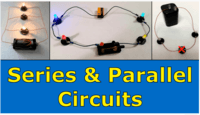
Series and Parallel Circuits

Flashcard
•
Science
•
5th Grade
•
Practice Problem
•
Hard
Standards-aligned

Wayground Content
FREE Resource
Student preview

15 questions
Show all answers
1.
FLASHCARD QUESTION
Front
What is a series circuit?
Back
A series circuit is a type of electrical circuit in which the components are connected end-to-end, so that the current flows through each component in turn. If one component fails, the entire circuit is interrupted.
2.
FLASHCARD QUESTION
Front
What is a parallel circuit?
Back
A parallel circuit is a type of electrical circuit in which the components are connected across common points or junctions, providing multiple paths for the current to flow. If one component fails, the current can still flow through other paths.
3.
FLASHCARD QUESTION
Front
What happens to the total resistance in a series circuit when more resistors are added?
Back
In a series circuit, the total resistance increases as more resistors are added. The total resistance (R_total) is the sum of all individual resistances (R_total = R1 + R2 + R3 + ...).
Tags
NGSS.MS-PS2-3
4.
FLASHCARD QUESTION
Front
What happens to the total resistance in a parallel circuit when more resistors are added?
Back
In a parallel circuit, the total resistance decreases as more resistors are added. The total resistance (R_total) can be calculated using the formula 1/R_total = 1/R1 + 1/R2 + 1/R3 + ...
5.
FLASHCARD QUESTION
Front
How does current behave in a series circuit?
Back
In a series circuit, the current is the same through all components. The total current flowing through the circuit is equal to the current flowing through each individual component.
6.
FLASHCARD QUESTION
Front
How does current behave in a parallel circuit?
Back
In a parallel circuit, the total current is divided among the different paths. The current flowing through each component can vary depending on the resistance of each path.
7.
FLASHCARD QUESTION
Front
What is the voltage across each component in a series circuit?
Back
In a series circuit, the total voltage is divided among the components. The voltage across each component depends on its resistance and can be calculated using Ohm's Law (V = IR).
Access all questions and much more by creating a free account
Create resources
Host any resource
Get auto-graded reports

Continue with Google

Continue with Email

Continue with Classlink

Continue with Clever
or continue with

Microsoft
%20(1).png)
Apple

Others
Already have an account?
Similar Resources on Wayground

10 questions
Mail Merge
Flashcard
•
6th Grade
10 questions
翰林國小英語 Dino 9 U3 文法測驗
Flashcard
•
6th Grade
15 questions
Dividing Decimals
Flashcard
•
5th Grade
15 questions
Math Vocabulary
Flashcard
•
4th Grade
8 questions
Understanding Heat Radiation
Flashcard
•
KG
9 questions
Women's Suffrage Movement Overview
Flashcard
•
5th Grade
8 questions
Moral Education Grade 5
Flashcard
•
5th Grade
16 questions
States of Matter
Flashcard
•
5th Grade
Popular Resources on Wayground
15 questions
Fractions on a Number Line

Quiz
•
3rd Grade
20 questions
Equivalent Fractions
Quiz
•
3rd Grade
25 questions
Multiplication Facts
Quiz
•
5th Grade
54 questions
Analyzing Line Graphs & Tables
Quiz
•
4th Grade
22 questions
fractions
Quiz
•
3rd Grade
20 questions
Main Idea and Details
Quiz
•
5th Grade
20 questions
Context Clues
Quiz
•
6th Grade
15 questions
Equivalent Fractions
Quiz
•
4th Grade
Discover more resources for Science
20 questions
The Water Cycle
Quiz
•
5th Grade
20 questions
Weathering, Erosion, Deposition
Quiz
•
5th Grade
28 questions
4th Grade The Need for Speed
Quiz
•
3rd - 5th Grade
20 questions
Food Chains and Food Webs Review
Quiz
•
5th Grade
20 questions
The Water Cycle
Quiz
•
4th - 5th Grade
21 questions
Solar System Review
Quiz
•
5th Grade
20 questions
Food Webs
Quiz
•
5th Grade
20 questions
Earth Processes and Landforms
Quiz
•
5th Grade