
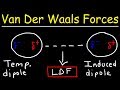
Understanding Van der Waals and London Dispersion Forces

Interactive Video
•
Chemistry, Science
•
9th - 12th Grade
•
Practice Problem
•
Hard

Sophia Harris
FREE Resource
Read more
10 questions
Show all answers
1.
MULTIPLE CHOICE QUESTION
30 sec • 1 pt
What are Van der Waals forces primarily associated with?
Ionic compounds
Metallic bonds
Nonpolar molecules
Polar molecules
2.
MULTIPLE CHOICE QUESTION
30 sec • 1 pt
What causes a temporary dipole in an atom?
Permanent electron distribution
Random electron movement
Proton movement
Nucleus distortion
3.
MULTIPLE CHOICE QUESTION
30 sec • 1 pt
Which atom is more likely to form a temporary dipole, fluorine or iodine?
Both equally
Iodine
Fluorine
Neither
4.
MULTIPLE CHOICE QUESTION
30 sec • 1 pt
What is an induced dipole?
A dipole that cannot revert
A permanent dipole
A dipole created by another dipole
A dipole that forms naturally
5.
MULTIPLE CHOICE QUESTION
30 sec • 1 pt
Why do nonpolar molecules have higher boiling points due to Van der Waals forces?
They have weaker covalent bonds
They have stronger ionic bonds
They have more electrons
They have fewer electrons
6.
MULTIPLE CHOICE QUESTION
30 sec • 1 pt
Which halogen has the highest boiling point?
Bromine
Fluorine
Iodine
Chlorine
7.
MULTIPLE CHOICE QUESTION
30 sec • 1 pt
What is the relationship between molecular weight and boiling point in nonpolar molecules?
No relationship
Inverse relationship
Direct relationship
Random relationship
Access all questions and much more by creating a free account
Create resources
Host any resource
Get auto-graded reports

Continue with Google

Continue with Email

Continue with Classlink

Continue with Clever
or continue with

Microsoft
%20(1).png)
Apple

Others
Already have an account?

