
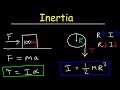
Understanding Inertia: Translational and Rotational Motion

Interactive Video
•
Physics, Science
•
8th - 12th Grade
•
Practice Problem
•
Medium

Liam Anderson
Used 10+ times
FREE Resource
Read more
10 questions
Show all answers
1.
MULTIPLE CHOICE QUESTION
30 sec • 1 pt
What is inertia?
The speed at which an object moves
The force required to move an object
The tendency of an object to resist changes in its state of motion
The tendency of an object to change its state of motion
2.
MULTIPLE CHOICE QUESTION
30 sec • 1 pt
According to Newton's first law, what happens to an object at rest?
It will accelerate
It will remain at rest unless acted upon by a net force
It will start moving on its own
It will change direction
3.
MULTIPLE CHOICE QUESTION
30 sec • 1 pt
How is inertia related to mass?
Inertia is not related to mass
Inertia is equal to mass
Inertia is inversely proportional to mass
Inertia is proportional to mass
4.
MULTIPLE CHOICE QUESTION
30 sec • 1 pt
What is the acceleration of a 10 kg object when a force of 50 N is applied?
10 m/s²
0.5 m/s²
50 m/s²
5 m/s²
5.
MULTIPLE CHOICE QUESTION
30 sec • 1 pt
Which object has more rotational inertia: a thin hoop or a solid disc with the same mass and radius?
Thin hoop
Solid disc
Neither has inertia
Both have the same inertia
6.
MULTIPLE CHOICE QUESTION
30 sec • 1 pt
Why does the thin hoop have more inertia than the solid disc?
Because it is lighter
Because its mass is concentrated at the edge
Because it has more mass
Because it has a larger radius
7.
MULTIPLE CHOICE QUESTION
30 sec • 1 pt
What is the formula for the rotational inertia of a solid disc?
m r²
1/2 m r²
2/5 m r²
m r
Access all questions and much more by creating a free account
Create resources
Host any resource
Get auto-graded reports

Continue with Google

Continue with Email

Continue with Classlink

Continue with Clever
or continue with

Microsoft
%20(1).png)
Apple

Others
Already have an account?

