
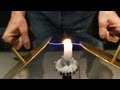
Understanding Candle Flames and Electric Fields

Interactive Video
•
Physics, Chemistry, Science
•
7th - 12th Grade
•
Practice Problem
•
Hard

Jackson Turner
FREE Resource
Read more
9 questions
Show all answers
1.
MULTIPLE CHOICE QUESTION
30 sec • 1 pt
Where is the experiment on candle flames conducted?
The Palace of Discovery in Paris
The Louvre Museum
The Eiffel Tower
The British Museum
2.
MULTIPLE CHOICE QUESTION
30 sec • 1 pt
What happens to the flame when an electric field is applied?
It changes color
It spreads out and separates into two parts
It extinguishes immediately
It becomes brighter
3.
MULTIPLE CHOICE QUESTION
30 sec • 1 pt
In the experiment, which ions move towards the negative plate?
Negative ions
Electrons
Positive ions
Neutral particles
4.
MULTIPLE CHOICE QUESTION
30 sec • 1 pt
How does the conductivity of a flame compare to air?
Air is a better conductor
Flame is a better insulator
Both are equally conductive
Flame is a better conductor
5.
MULTIPLE CHOICE QUESTION
30 sec • 1 pt
What voltage is required to break down a centimeter of air?
20,000 volts
15,000 volts
10,000 volts
5,000 volts
6.
MULTIPLE CHOICE QUESTION
30 sec • 1 pt
What can a strong enough electric field do to a flame?
Make it brighter
Change its color
Increase its temperature
Extinguish it
7.
MULTIPLE CHOICE QUESTION
30 sec • 1 pt
What happens to the charges in smoke when the flame goes out?
They become neutral
They disappear
They are pulled in opposite directions
They combine
Access all questions and much more by creating a free account
Create resources
Host any resource
Get auto-graded reports

Continue with Google

Continue with Email

Continue with Classlink

Continue with Clever
or continue with

Microsoft
%20(1).png)
Apple

Others
Already have an account?

