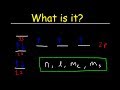
Understanding Electron Configuration Principles

Interactive Video
•
Physics, Chemistry, Science
•
9th - 12th Grade
•
Practice Problem
•
Hard

Amelia Wright
FREE Resource
Read more
10 questions
Show all answers
1.
MULTIPLE CHOICE QUESTION
30 sec • 1 pt
According to the Aufbau principle, where should the first electron be placed?
In the 3s sublevel
In the 2p sublevel
In the 1s sublevel
In the highest energy level
2.
MULTIPLE CHOICE QUESTION
30 sec • 1 pt
What is the main idea of Hund's Rule?
Electrons fill the highest energy level first
Electrons pair up in the same orbital
Electrons fill degenerate orbitals with parallel spins
Electrons have opposite spins in the same orbital
3.
MULTIPLE CHOICE QUESTION
30 sec • 1 pt
Why do electrons prefer to be unpaired according to Hund's Rule?
Unpaired electrons experience less repulsion
Unpaired electrons are less stable
Paired electrons have lower energy
Paired electrons are more stable
4.
MULTIPLE CHOICE QUESTION
30 sec • 1 pt
What happens when electrons begin to pair up in orbitals?
They create a more stable configuration
They fill higher energy levels first
They increase the energy of the atom
They decrease the energy of the atom
5.
MULTIPLE CHOICE QUESTION
30 sec • 1 pt
What does Pauli's Exclusion Principle state about electrons?
No two electrons can have the same set of four quantum numbers
Electrons fill the highest energy level first
Electrons can share the same set of quantum numbers
Electrons must have opposite spins in the same orbital
6.
MULTIPLE CHOICE QUESTION
30 sec • 1 pt
Which quantum number describes the shape of an orbital?
Angular momentum quantum number (l)
Magnetic quantum number (ml)
Spin quantum number (ms)
Principal quantum number (n)
7.
MULTIPLE CHOICE QUESTION
30 sec • 1 pt
What is the spin quantum number for an electron with an upward spin?
0
-1/2
+1
+1/2
Access all questions and much more by creating a free account
Create resources
Host any resource
Get auto-graded reports

Continue with Google

Continue with Email

Continue with Classlink

Continue with Clever
or continue with

Microsoft
%20(1).png)
Apple

Others
Already have an account?
Similar Resources on Wayground

11 questions
Redox Reactions and Electron Transfer
Interactive video
•
9th - 12th Grade
11 questions
Understanding the Evolution and Future of Computing Technology
Interactive video
•
9th - 12th Grade
11 questions
Understanding Entropy and Thermodynamics
Interactive video
•
9th - 12th Grade
11 questions
Understanding Lenz's Law and Induced Currents
Interactive video
•
9th - 12th Grade
11 questions
Quantum Mechanics and Light
Interactive video
•
9th - 12th Grade
11 questions
Cyclotron Physics and Particle Motion
Interactive video
•
9th - 12th Grade
11 questions
Gravity and Its Effects
Interactive video
•
9th - 12th Grade
11 questions
Michael Faraday and Electromagnetism Quiz
Interactive video
•
9th - 12th Grade
Popular Resources on Wayground
7 questions
History of Valentine's Day
Interactive video
•
4th Grade
15 questions
Fractions on a Number Line

Quiz
•
3rd Grade
20 questions
Equivalent Fractions
Quiz
•
3rd Grade
25 questions
Multiplication Facts
Quiz
•
5th Grade
22 questions
fractions
Quiz
•
3rd Grade
15 questions
Valentine's Day Trivia
Quiz
•
3rd Grade
20 questions
Main Idea and Details
Quiz
•
5th Grade
20 questions
Context Clues
Quiz
•
6th Grade
Discover more resources for Physics
10 questions
Exit Check 3.1 - Kepler's Laws
Quiz
•
9th Grade
10 questions
Exit Check 3.2 - Force of Gavity
Quiz
•
9th Grade
21 questions
Potential and Kinetic Energy
Quiz
•
11th Grade
27 questions
Simple Machines and Mechanical Advantage Quiz
Quiz
•
9th Grade
15 questions
Circuits Review Quiz
Quiz
•
12th Grade
20 questions
Unit 8 - Energy Test - 2025-2026
Quiz
•
9th - 12th Grade
19 questions
Generators, Motors, and Transformers
Quiz
•
8th Grade - University
13 questions
Series Circuits and Parallel Circuits
Quiz
•
12th Grade