
154_S&P_Aishwariya
Authored by Aishwariya Hariharan
Mathematics
9th - 12th Grade


AI Actions
Add similar questions
Adjust reading levels
Convert to real-world scenario
Translate activity
More...
Content View
Student View
35 questions
Show all answers
1.
MULTIPLE CHOICE QUESTION
3 mins • 1 pt
Given the probability model in the table below, what is the expected value of the random variable?
X 50 20 5
P(X) 0.1 0.3 0.6
2.
MULTIPLE CHOICE QUESTION
3 mins • 1 pt
A marketing survey compiled data on the number of cars in households. If X = the number of cars in a randomly selected household, and we omit the rare cases of more than 5 cars, then X has the following probability distribution:
X 0 1 2 3 4 5
P(X) 0.24 0.37 0.20 0.11 0.05 0.03
What is the probability that a randomly chosen household has at least two cars?
3.
MULTIPLE CHOICE QUESTION
2 mins • 1 pt
What type of probability is a way of estimating the probability of an event happening based on repeated trials?
Experimental Probabillity
Theoretical Probability
4.
MULTIPLE CHOICE QUESTION
2 mins • 1 pt

Kate spun the spinner 75 times and landed on "3" thirty times.
What is the experimental probability as a percentage?
20%
30%
40%
50%
5.
MULTIPLE CHOICE QUESTION
2 mins • 1 pt

Jill rolled a "5" fifteen times out of 20 rolls on a dice.
What is the experimental probability as a SIMPLIFIED FRACTION!
3/7
3/6
3/5
3/4
6.
MULTIPLE CHOICE QUESTION
2 mins • 1 pt
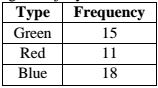
Shannon has a bag of jelly beans.
5 Green
2 Red
3 Blue
What is the experimental probability of her selecting a red jelly bean?
11/33
2/10
1/5
23/30
7.
MULTIPLE CHOICE QUESTION
2 mins • 1 pt

Determine the type of probability:
Damon flipped a coin 50 times and got 31 heads.
Based on the results, the probability of heads is 31/50, or 62%.
Theoretical Probability
Experimental Probability

Access all questions and much more by creating a free account
Create resources
Host any resource
Get auto-graded reports

Continue with Google

Continue with Email

Continue with Microsoft
or continue with

%20(1).png)
Apple

Others
Already have an account?


