
Inclined Plane Problems
Authored by John Judkins
Physics
9th - 12th Grade
NGSS covered


AI Actions
Add similar questions
Adjust reading levels
Convert to real-world scenario
Translate activity
More...
Content View
Student View
14 questions
Show all answers
1.
MULTIPLE CHOICE QUESTION
1 min • 1 pt
What do the arrows or vectors represent?
Forces acting on the object
All the acceleration acting on the object
All the ways an object can move
Answer explanation
The arrows or vectors represent forces acting on the object. They indicate the direction and magnitude of these forces, which are crucial for understanding the object's motion and interactions.
Tags
NGSS.HS-PS2-1
2.
MULTIPLE SELECT QUESTION
1 min • 1 pt

This object could be moving in which directions? (pick all that are correct):
Up
Down
Left
Right
Answer explanation
The object can move Up and Right, as these directions are typically associated with positive vertical and horizontal movement. Down and Left are not correct in this context.
Tags
NGSS.HS-PS2-1
3.
MULTIPLE CHOICE QUESTION
2 mins • 1 pt

The diagram above shows a box being pulled up the ramp. Which letter represents the weight?
A
B
C
D
Answer explanation
In the diagram, the weight of the box is represented by letter B. Weight acts vertically downward due to gravity, which is typically shown as a downward arrow in such diagrams.
Tags
NGSS.HS-PS2-1
4.
MULTIPLE CHOICE QUESTION
30 sec • 1 pt
What is the role of friction in a Free Body Diagram?
To oppose the motion of an object
To increase the speed of an object
To balance the gravitational force
To act perpendicular to the surface
Answer explanation
Friction acts to oppose the motion of an object, making it a resistive force. In a Free Body Diagram, it is represented as an arrow pointing opposite to the direction of motion, highlighting its role in slowing down or stopping movement.
Tags
NGSS.MS-PS2-2
5.
MULTIPLE CHOICE QUESTION
2 mins • 1 pt
Which inclined plane requires the most force to push the ball to the top?
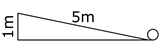
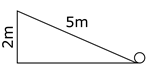
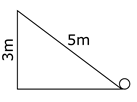
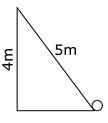
Tags
NGSS.HS-PS2-1
6.
MULTIPLE CHOICE QUESTION
15 mins • 1 pt
A 3.0-kg block slides on a frictionless 20° inclined plane. A force of 16 N acting parallel to the incline and up the incline is applied to the block. What is the acceleration of the block?
2 m/s^2 down the incline
5.3 m/s^2 up the incline
2 m/s^2 up the incline
3.9 m/s^2 down the incline
Answer explanation
To find the acceleration, calculate the net force: F_net = applied force - weight component down the incline. Weight component = mg sin(20°) = 3.0 kg * 9.8 m/s² * sin(20°) ≈ 10.1 N. F_net = 16 N - 10.1 N = 5.9 N. Acceleration = F_net/m = 5.9 N / 3.0 kg ≈ 2 m/s² up the incline.
Tags
NGSS.HS-PS2-1
7.
MULTIPLE CHOICE QUESTION
15 mins • 1 pt
A 20.0-kilogram mass held at rest on a frictionless 25.0º incline by force F. What is the magnitude of force F?
49.1N
98.1N
83N
9.81N
Answer explanation
To find force F, calculate the component of gravitational force down the incline: F = mg sin(θ). Here, m = 20 kg, g = 9.81 m/s², and θ = 25º. Thus, F = 20 * 9.81 * sin(25º) ≈ 83N.
Tags
NGSS.HS-PS2-1
Access all questions and much more by creating a free account
Create resources
Host any resource
Get auto-graded reports

Continue with Google

Continue with Email

Continue with Classlink

Continue with Clever
or continue with

Microsoft
%20(1).png)
Apple

Others
Already have an account?
Similar Resources on Wayground

10 questions
Magnetism - Review

Quiz
•
9th Grade
10 questions
Particle and nuclear Physics (AS Physics)
Quiz
•
12th Grade
17 questions
Year 10 Science - Energy
Quiz
•
8th - 10th Grade
12 questions
DIODE - HALF WAVE AND FULL WAVE RECTIFICATION
Quiz
•
11th - 12th Grade
15 questions
Magnetism and magnetic effect
Quiz
•
12th Grade
17 questions
Isaac Newton's Laws Of Motion
Quiz
•
7th - 9th Grade
13 questions
MECHANICAL: Physics Equations on energy, work and power
Quiz
•
7th - 10th Grade
10 questions
EM Waves
Quiz
•
7th - 10th Grade
Popular Resources on Wayground
7 questions
History of Valentine's Day

Interactive video
•
4th Grade
15 questions
Fractions on a Number Line
Quiz
•
3rd Grade
20 questions
Equivalent Fractions
Quiz
•
3rd Grade
25 questions
Multiplication Facts
Quiz
•
5th Grade
22 questions
fractions
Quiz
•
3rd Grade
15 questions
Valentine's Day Trivia
Quiz
•
3rd Grade
20 questions
Main Idea and Details
Quiz
•
5th Grade
20 questions
Context Clues
Quiz
•
6th Grade
Discover more resources for Physics
10 questions
Exit Check 3.1 - Kepler's Laws
Quiz
•
9th Grade
10 questions
Exit Check 3.2 - Force of Gavity
Quiz
•
9th Grade
21 questions
Potential and Kinetic Energy
Quiz
•
11th Grade
27 questions
Simple Machines and Mechanical Advantage Quiz
Quiz
•
9th Grade
15 questions
Circuits Review Quiz
Quiz
•
12th Grade
20 questions
Unit 8 - Energy Test - 2025-2026
Quiz
•
9th - 12th Grade
19 questions
Generators, Motors, and Transformers
Quiz
•
8th Grade - University
13 questions
Series Circuits and Parallel Circuits
Quiz
•
12th Grade