
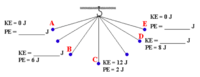
Conservation of Energy

Flashcard
•
Physics
•
9th - 12th Grade
•
Practice Problem
•
Hard

Wayground Content
FREE Resource
Student preview

15 questions
Show all answers
1.
FLASHCARD QUESTION
Front
What is the definition of Gravitational Potential Energy (GPE)?
Back
Gravitational Potential Energy (GPE) is the energy an object possesses due to its position in a gravitational field, calculated as GPE = mgh, where m is mass, g is the acceleration due to gravity, and h is height.
2.
FLASHCARD QUESTION
Front
What is the definition of Kinetic Energy (KE)?
Back
Kinetic Energy (KE) is the energy an object has due to its motion, calculated as KE = 1/2 mv², where m is mass and v is velocity.
3.
FLASHCARD QUESTION
Front
What is the Law of Conservation of Energy?
Back
The Law of Conservation of Energy states that energy cannot be created or destroyed, only transformed from one form to another.
4.
FLASHCARD QUESTION
Front
How do you calculate Total Mechanical Energy?
Back
Total Mechanical Energy is the sum of Gravitational Potential Energy (GPE) and Kinetic Energy (KE): Total Energy = GPE + KE.
5.
FLASHCARD QUESTION
Front
What happens to GPE as an object falls?
Back
As an object falls, its Gravitational Potential Energy (GPE) decreases while its Kinetic Energy (KE) increases, keeping the total mechanical energy constant.
6.
FLASHCARD QUESTION
Front
What is the relationship between GPE and height?
Back
Gravitational Potential Energy (GPE) is directly proportional to height; as height increases, GPE increases.
7.
FLASHCARD QUESTION
Front
What is the relationship between KE and speed?
Back
Kinetic Energy (KE) is proportional to the square of the speed; if speed doubles, KE increases by a factor of four.
Access all questions and much more by creating a free account
Create resources
Host any resource
Get auto-graded reports

Continue with Google

Continue with Email

Continue with Classlink

Continue with Clever
or continue with

Microsoft
%20(1).png)
Apple

Others
Already have an account?



