
Signal Processing Quiz
Authored by Alicia Pollard
Science
8th Grade
NGSS covered
Used 13+ times


AI Actions
Add similar questions
Adjust reading levels
Convert to real-world scenario
Translate activity
More...
Content View
Student View
23 questions
Show all answers
1.
MULTIPLE CHOICE QUESTION
30 sec • 1 pt
How does the total amount of information differ between an analog and a digital signal?
A digital signal has more information because it has more values than an analog signal.
A digital signal has more information because it has fewer values than an analog signal.
An analog signal has more information because it has more values than a digital signal.
An analog signal has more information because it has fewer values than a digital signal.
Tags
NGSS.MS-PS4-3
2.
MULTIPLE CHOICE QUESTION
30 sec • 1 pt
Why do most modern devices use digital signals?
Digital signals contain more information than analog signals.
Digital signals are more reliable over long distances than analog signals.
Analog signals contain more information than digital signals.
Analog signals are more reliable over long distances than digital signals.
Tags
NGSS.MS-PS4-3
3.
FILL IN THE BLANK QUESTION
30 sec • 1 pt
A transmitter on the moon emits sound and light waves to a receiver on Earth. The light waves are picked up by the receiver but sound waves are not. This happens because _______________.
4.
MULTIPLE CHOICE QUESTION
30 sec • 1 pt

Which part of the longitudinal wave shown above represents one wavelength?
Part A
Part B
Part C
Part D
Tags
NGSS.MS-PS4-1
5.
MULTIPLE CHOICE QUESTION
30 sec • 1 pt
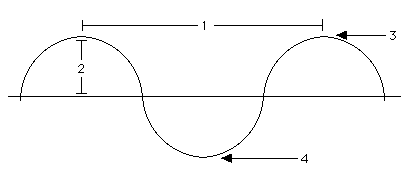
The diagram above shows a triangular wave. Which lettered part represents the amplitude of the wave?
Part 1
Part 2
Part 3
Part 4
Tags
NGSS.MS-PS4-1
6.
FILL IN THE BLANK QUESTION
30 sec • 1 pt
Plucking a guitar string creates a wave whose motion is perpendicular to the downward force on the strings. The movement of the string is an example of a ___________.
7.
MULTIPLE SELECT QUESTION
30 sec • 1 pt
Select the phrases below that are characteristics of sound waves. (NOTE: select more than one answer.)
Travels faster in solids than through air
Always travels at the same speed
Causes molecules to increase in size
Can travel through any type of matter
Can cause objects to vibrate
Tags
NGSS.MS-PS4-2
Access all questions and much more by creating a free account
Create resources
Host any resource
Get auto-graded reports

Continue with Google

Continue with Email

Continue with Classlink

Continue with Clever
or continue with

Microsoft
%20(1).png)
Apple

Others
Already have an account?
Similar Resources on Wayground

20 questions
3rd PT REVIEW in Science 6

Quiz
•
6th Grade - University
20 questions
Changes in States of Matter
Quiz
•
8th Grade
20 questions
Astronomy by Sakarya Bilsem
Quiz
•
3rd - 8th Grade
20 questions
Fault and Earthquake
Quiz
•
8th Grade
20 questions
Matter: Lessons 5, 6, 7 (in book)
Quiz
•
5th - 12th Grade
20 questions
Simple Machines: First Class Levers
Quiz
•
6th - 8th Grade
20 questions
THE SOLAR SYSTEM AND BEYOND
Quiz
•
7th - 9th Grade
20 questions
Yr 89 Chemical Sciences Review Part 2
Quiz
•
8th Grade
Popular Resources on Wayground
15 questions
Fractions on a Number Line
Quiz
•
3rd Grade
20 questions
Equivalent Fractions
Quiz
•
3rd Grade
25 questions
Multiplication Facts
Quiz
•
5th Grade
54 questions
Analyzing Line Graphs & Tables
Quiz
•
4th Grade
22 questions
fractions
Quiz
•
3rd Grade
20 questions
Main Idea and Details
Quiz
•
5th Grade
20 questions
Context Clues
Quiz
•
6th Grade
15 questions
Equivalent Fractions
Quiz
•
4th Grade
Discover more resources for Science
20 questions
Cell Organelles and Functions
Quiz
•
6th - 8th Grade
33 questions
Grade 6 Quarter 3 PMA 5 Review
Quiz
•
6th - 8th Grade
10 questions
Exploring the Rock Cycle: Types and Formation

Interactive video
•
6th - 8th Grade
10 questions
Exploring the Layers of the Earth
Interactive video
•
6th - 10th Grade
14 questions
Biodiversity and Sustainability Quiz
Quiz
•
8th Grade
20 questions
Heredity Punnett square review
Quiz
•
8th Grade
23 questions
Newton's 3 Laws of Motion
Quiz
•
8th Grade
10 questions
Exploring the Rock Cycle
Interactive video
•
6th - 8th Grade