
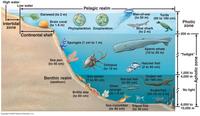
Ocean Zones & Adaptations

Flashcard
•
Biology
•
11th - 12th Grade
•
Practice Problem
•
Hard

Wayground Content
FREE Resource
Student preview

15 questions
Show all answers
1.
FLASHCARD QUESTION
Front
What is the Intertidal Zone (High Tide)?
Back
The area of the shoreline that is submerged during high tide and exposed during low tide, where organisms must adapt to changing conditions.
2.
FLASHCARD QUESTION
Front
What is the Intertidal Zone (Low Tide)?
Back
The area of the shoreline that is exposed during low tide, where organisms like marine mussels can clump together to reduce water loss.
3.
FLASHCARD QUESTION
Front
What is the Photic Zone?
Back
The upper layer of the ocean where sunlight penetrates, allowing photosynthesis and supporting most marine life.
4.
FLASHCARD QUESTION
Front
What is the Ocean (Aphotic Zone)?
Back
The deep ocean layer where sunlight does not reach, characterized by darkness and specialized organisms like the black dragonfish.
5.
FLASHCARD QUESTION
Front
What adaptations do organisms in the Intertidal Zone (High Tide) have?
Back
Organisms have adaptations to withstand wave action and varying water levels, such as strong attachments to rocks.
6.
FLASHCARD QUESTION
Front
What adaptations do organisms in the Intertidal Zone (Low Tide) have?
Back
Organisms can tolerate exposure to air and have mechanisms to retain moisture, like clumping together.
7.
FLASHCARD QUESTION
Front
What is the significance of photophores in deep-sea fish?
Back
Photophores are specialized organs that produce light, helping deep-sea fish like the black dragonfish attract prey and communicate.
Access all questions and much more by creating a free account
Create resources
Host any resource
Get auto-graded reports

Continue with Google

Continue with Email

Continue with Classlink

Continue with Clever
or continue with

Microsoft
%20(1).png)
Apple

Others
Already have an account?


