
Diffusion,Osmosis, Active Transport
10th Grade
•15 Qs

Similar activities
Evolution and Biodiversity Final Exam Review
9th - 12th Grade
•16 Qs
Working scientifically
10th - 11th Grade
•10 Qs
2. Biodiversity
10th Grade
•10 Qs
Energie in voeding
7th - 12th Grade
•10 Qs
Water Pollution Vocabulary
9th - 10th Grade
•12 Qs
Chapter 1.3 Vocabulary Quiz
9th - 10th Grade
•10 Qs
Animal Tissue
6th - 10th Grade
•15 Qs
Regions and Function of the Brain
10th - 12th Grade
•20 Qs
Diffusion,Osmosis, Active Transport

Quiz
•
Biology
•
10th Grade
•
Practice Problem
•
Medium
+2
Standards-aligned

Eko Hartono
Used 2K+ times
FREE Resource

Enhance your content in a minute
15 questions
Show all answers
1.
MULTIPLE CHOICE QUESTION
1 min • 1 pt
Diffusion is the net movement of molecule from a region of ...1...to region of ...2....
1: lower concentration, 2: higher concentration
1: higher concentration, 2: lower concentration
1: lower concentration, 2: lower concentration
1: higher concentration, 2: higher concentration
Tags
NGSS.MS-PS1-2
2.
MULTIPLE CHOICE QUESTION
1 min • 1 pt

Two Erlenmeyer flasks are arranged as the diagram below. After several minutes, all of Erlenmeyer flasks are filled up by glucose solution. Why did it happen?
It happens because of diffusion
It happens because of osmosis
It happens because of gravitation force
It happens because of shaking hands
3.
MULTIPLE CHOICE QUESTION
1 min • 1 pt
Osmosis is the passage of ...1... molecules from a region of their higher concentration to a region of their lower concentration through a ... 2 ... permeable membrane
1: sugar, 2: completely
1: sugar, 2: partially
1: water, 2: completely
1: water, 2: partially
4.
MULTIPLE CHOICE QUESTION
1 min • 1 pt

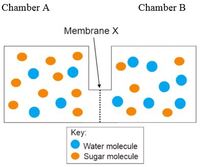
The diagram shows two chambers with different concentration of molecules separated by a selectively permeable membrane. Predict what will happen to the water molecules ?
move from B to A due to diffusion
move from B to A due to osmosis
move from B to A due to active transport
move from A to B due to osmosis
5.
MULTIPLE CHOICE QUESTION
45 sec • 1 pt
Active transport is movement of particles through the cell membrane from a region of ...1... to a region of ...2... using energy in the form of ...3...
1: lower concentration, 2: higher concentration, 3: NADPH
1: higher concentration, 2: lower concentration, 3: NADPH
1: higher concentration, 2: lower concentration, 3: ATP
1: lower concentration, 2: higher concentration, 3: ATP
Tags
NGSS.HS-LS1-3
6.
MULTIPLE CHOICE QUESTION
1 min • 1 pt
Which of the following is a sample of active transport?
movement of oxygen from alveoli into red blood cell
movement of water across cell membrane
plant root absorbing mineral ions from the soil
uptake of water by the root hair of the plant
7.
MULTIPLE CHOICE QUESTION
1 min • 1 pt
Which of the following is a sample of osmosis?
plant root absorbing mineral ions from the soil
the scent from a bunch of flowers spreads throughout a room
carbon dioxide move from air into leaves through stomata.
plant root absorbing water from the soil
Tags
NGSS.MS-LS2-3


Access all questions and much more by creating a free account
Create resources
Host any resource
Get auto-graded reports

Continue with Google

Continue with Email

Continue with Classlink

Continue with Clever
or continue with

Microsoft
%20(1).png)
Apple

Others
Already have an account?
Similar Resources on Wayground
10 questions
Energie in voeding
Quiz
•
7th - 12th Grade
20 questions
Regions and Function of the Brain
Quiz
•
10th - 12th Grade
10 questions
Prokayotic and Eukaryotic Cells.
Quiz
•
7th - 10th Grade
12 questions
SYNOVIAL JOINTS & BONE DISORDERS
Quiz
•
10th Grade
10 questions
What are life processes?
Quiz
•
7th - 10th Grade
10 questions
Heterotrophic Nutrition
Quiz
•
10th Grade
20 questions
AQA B3 Keyword Revision
Quiz
•
8th - 10th Grade
10 questions
2. Biodiversity
Quiz
•
10th Grade
Popular Resources on Wayground
15 questions
Fractions on a Number Line
Quiz
•
3rd Grade
20 questions
Equivalent Fractions
Quiz
•
3rd Grade
25 questions
Multiplication Facts
Quiz
•
5th Grade
54 questions
Analyzing Line Graphs & Tables
Quiz
•
4th Grade
22 questions
fractions
Quiz
•
3rd Grade
20 questions
Main Idea and Details
Quiz
•
5th Grade
20 questions
Context Clues
Quiz
•
6th Grade
15 questions
Equivalent Fractions
Quiz
•
4th Grade
Discover more resources for Biology
21 questions
Meiosis Vs Mitosis
Quiz
•
10th Grade
10 questions
Comparing Mitosis and Meiosis: Key Differences and Stages

Interactive video
•
6th - 10th Grade
20 questions
Cladogram Practice
Quiz
•
10th Grade
10 questions
Cell Structure and Function Concepts
Interactive video
•
6th - 10th Grade
20 questions
Evidence of Evolution
Quiz
•
9th - 10th Grade
16 questions
MATZKE Photosynthesis/Respiration
Quiz
•
9th - 12th Grade
40 questions
Sea Otters Quiz #2
Quiz
•
10th Grade
20 questions
Punnets and Pedigrees
Quiz
•
9th - 10th Grade