
Pedigree Practice

Quiz
•
Biology
•
6th - 8th Grade
•
Hard
Standards-aligned

Karri Dawes
FREE Resource
Student preview

15 questions
Show all answers
1.
MULTIPLE CHOICE QUESTION
2 mins • 1 pt

Is this trait (the shaded individuals) dominant or recessive?
Tags
NGSS.HS-LS3-1
NGSS.HS-LS3-2
2.
MULTIPLE CHOICE QUESTION
30 sec • 1 pt

What do half colored symbols represent?
Tags
NGSS.HS-LS3-1
NGSS.HS-LS3-2
3.
MULTIPLE CHOICE QUESTION
30 sec • 1 pt
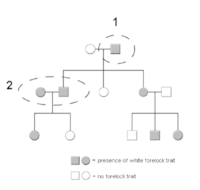
Examine the pedigree. The allele for the presence of a widow’s peak is dominant. Therefore, we can tell from the chart that in the couple labeled 2:
Tags
NGSS.HS-LS3-1
4.
MULTIPLE CHOICE QUESTION
30 sec • 1 pt

How many generations are shown in this pedigree?
5.
MULTIPLE CHOICE QUESTION
5 mins • 1 pt

Give the genotype for person II-1, for this autosomal trait.
GG
Gg
gg
we cannot be 100% sure of the genotype
Tags
NGSS.HS-LS3-1
NGSS.HS-LS3-2
6.
MULTIPLE CHOICE QUESTION
2 mins • 1 pt

There are no carriers for Huntington's Disease - you either have it or you don't. Is Huntington's disease caused by a dominant or recessive trait? (hint - Every generation has a shaded person)
Dominant
Recessive
Tags
NGSS.HS-LS3-1
7.
MULTIPLE CHOICE QUESTION
30 sec • 1 pt
Examine the pedigree. The allele for the presence of a widow’s peak is dominant. Therefore, we can tell from the chart that in the couple labeled 2:
the male is heterozygous and the female is homozygous.
the male is homozygous and the female is heterozygous.
Both the male and the female are homozygous.
Both the male and the female are heterozygous.
Tags
NGSS.HS-LS3-1


Access all questions and much more by creating a free account
Create resources
Host any resource
Get auto-graded reports

Continue with Google

Continue with Email

Continue with Classlink

Continue with Clever
or continue with

Microsoft
%20(1).png)
Apple

Others
Already have an account?
Popular Resources on Wayground

15 questions
Fractions on a Number Line
Quiz
•
3rd Grade
20 questions
Equivalent Fractions
Quiz
•
3rd Grade
25 questions
Multiplication Facts
Quiz
•
5th Grade
22 questions
fractions
Quiz
•
3rd Grade
20 questions
Main Idea and Details
Quiz
•
5th Grade
20 questions
Context Clues
Quiz
•
6th Grade
15 questions
Equivalent Fractions
Quiz
•
4th Grade
20 questions
Figurative Language Review
Quiz
•
6th Grade
Discover more resources for Biology
10 questions
Comparing Mitosis and Meiosis: Key Differences and Stages

Interactive video
•
6th - 10th Grade
20 questions
cell theory and organelles
Quiz
•
6th - 8th Grade
14 questions
Reading Comprehension SC.7.L.15.1

Passage
•
8th Grade
10 questions
Cell Structure and Function Concepts
Interactive video
•
6th - 10th Grade
20 questions
The Cell Cycle
Quiz
•
7th Grade
10 questions
Natural Selection and Adaptation in Evolution
Interactive video
•
6th - 10th Grade
15 questions
Pedigrees
Quiz
•
7th - 12th Grade
10 questions
Cellular Respiration
Quiz
•
7th - 8th Grade