
Statistics: Interpreting Graphs and Charts
Authored by Anthony Clark
Mathematics
6th Grade
CCSS covered
Used 1+ times


AI Actions
Add similar questions
Adjust reading levels
Convert to real-world scenario
Translate activity
More...
Content View
Student View
20 questions
Show all answers
1.
MULTIPLE CHOICE QUESTION
1 min • 1 pt

How many more pizzas were sold by Uncle John's Pizza than Little Secrets Pizza?
40
200
210
45
Tags
CCSS.1.NBT.A.1
2.
MULTIPLE CHOICE QUESTION
1 min • 1 pt
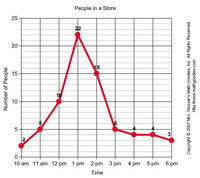
When was the greatest amount of shoppers at the store?
10am
1pm
6pm
2pm
3.
MULTIPLE CHOICE QUESTION
1 min • 1 pt

How many birds are represented by the green sector?
5
20
9
13
4.
MULTIPLE CHOICE QUESTION
1 min • 1 pt
A scatter plot shows the relationship between hours studied and test scores. If there is a trend line going upwards, what does this suggest?
As study hours decrease, test scores increase.
As study hours increase, test scores decrease.
As study hours increase, test scores increase.
There is no relationship between study hours and test scores.
5.
MULTIPLE CHOICE QUESTION
1 min • 1 pt
A histogram displays the number of hours students spend on homework each week. If the 0-1 hour range has the smallest bar, what does this suggest?
No students spend 0-1 hour on homework.
Few students spend only 0-1 hour on homework each week.
Most students spend 0-1 hour on homework.
The data is incorrect.
6.
MULTIPLE CHOICE QUESTION
1 min • 1 pt
A pie chart represents the types of books read by a class. If 30% of the chart is dedicated to fiction books, what does this percentage signify?
30% of the books are non-fiction.
30% of the students dislike fiction.
30% of the books read are fiction.
Each student reads 30 fiction books.
7.
MULTIPLE CHOICE QUESTION
1 min • 1 pt
A histogram shows the distribution of students' ages in a school. If the 10-12 age group has the highest frequency, what does this tell us?
Students aged 10-12 are the youngest.
Most students are aged between 10 and 12.
No students are older than 12.
Students aged 10-12 are the majority.

Access all questions and much more by creating a free account
Create resources
Host any resource
Get auto-graded reports

Continue with Google

Continue with Email

Continue with Classlink

Continue with Clever
or continue with

Microsoft
%20(1).png)
Apple

Others
Already have an account?
Similar Resources on Wayground

16 questions
Multiplying Fractions

Quiz
•
7th - 8th Grade
17 questions
Reviewer for Final Exam
Quiz
•
10th Grade
15 questions
Unit Circle Scavenger Hunt
Quiz
•
11th Grade
20 questions
BM Topic 1 Quiz
Quiz
•
University
18 questions
Classwork 1
Quiz
•
9th Grade
15 questions
Standard Form
Quiz
•
9th Grade
20 questions
Class 7 Online Quiz 2
Quiz
•
7th Grade
20 questions
Conversion Metric to Metric
Quiz
•
7th Grade - University
Popular Resources on Wayground
8 questions
Spartan Way - Classroom Responsible
Quiz
•
9th - 12th Grade
15 questions
Fractions on a Number Line
Quiz
•
3rd Grade
14 questions
Boundaries & Healthy Relationships

Lesson
•
6th - 8th Grade
20 questions
Equivalent Fractions
Quiz
•
3rd Grade
3 questions
Integrity and Your Health
Lesson
•
6th - 8th Grade
25 questions
Multiplication Facts
Quiz
•
5th Grade
9 questions
FOREST Perception
Lesson
•
KG
20 questions
Main Idea and Details
Quiz
•
5th Grade
Discover more resources for Mathematics
12 questions
Review: Surface Area of Rectangular and Triangular Prisms
Quiz
•
6th Grade
36 questions
6th Grade Math STAAR Review
Quiz
•
6th Grade
26 questions
Graphing Inequalities on a Number Line
Quiz
•
6th Grade
20 questions
Graphing Inequalities on a Number Line
Quiz
•
6th - 9th Grade
15 questions
Distributive Property & Review
Quiz
•
6th Grade
20 questions
Math Review
Quiz
•
6th Grade
15 questions
Mean, Median, Mode, and Range
Quiz
•
6th Grade
7 questions
Understanding Parallel, Intersecting, and Perpendicular Lines

Interactive video
•
1st - 6th Grade