
Theoretical Probability Sample Space
Authored by Anthony Clark
Mathematics
7th Grade
Used 10+ times


AI Actions
Add similar questions
Adjust reading levels
Convert to real-world scenario
Translate activity
More...
Content View
Student View
10 questions
Show all answers
1.
MULTIPLE CHOICE QUESTION
1 min • 1 pt
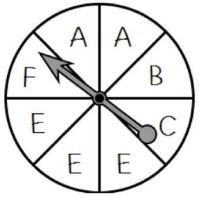
P(not A) =
6/8
3/4
2/8
1/4
2.
MULTIPLE CHOICE QUESTION
1 min • 1 pt

Which shows the sample space for flipping two coins?
H = heads, T = tails
H, T
HH, HT, TH, TT
HH, TT
HH, TT, TT, HH
3.
MULTIPLE CHOICE QUESTION
1 min • 1 pt

The sample space tree diagram for a team of three students is shown. What is the probability that the team would consist of at least 2 girls?
½
⅜
¾
⅙
4.
MULTIPLE CHOICE QUESTION
1 min • 1 pt

Which statement below is true?
The theoretical probability of rolling a 3 is greater than the experimental probability of rolling a 3
The theoretical probability of rolling a 3 is less than the experimental probability of rolling a 3
The theoretical probability of rolling a 3 is equal to the experimental probability of rolling a 3
You cannot determine the theoretical probability.
5.
MULTIPLE CHOICE QUESTION
1 min • 1 pt
The extent to which something is likely to occur is known as -
sample space
an event
probability
data
6.
MULTIPLE CHOICE QUESTION
1 min • 1 pt
The number of ways an event can occur divided by the total number of outcomes is known as -
an event complement
experimental probability
an event
theoretical probability
7.
MULTIPLE CHOICE QUESTION
1 min • 1 pt
A set of all possible outcomes is known as -
a list
a complement
a sample space
an event
Access all questions and much more by creating a free account
Create resources
Host any resource
Get auto-graded reports

Continue with Google

Continue with Email

Continue with Classlink

Continue with Clever
or continue with

Microsoft
%20(1).png)
Apple

Others
Already have an account?


