
- Resource Library
- Math
- Probability And Statistics
- Experimental Probability
- Theoretical Probability Vs Experimental Probability Simulations
Theoretical Probability vs Experimental Probability Simulations
Authored by Anthony Clark
Mathematics
7th Grade
Used 13+ times


AI Actions
Add similar questions
Adjust reading levels
Convert to real-world scenario
Translate activity
More...
Content View
Student View
20 questions
Show all answers
1.
MULTIPLE CHOICE QUESTION
1 min • 1 pt
A dice was rolled five times and the following were rolled: 1, 3, 3, 4, 4
Based on this information, find the experimental P(1).
3/5
1/6
2/5
1/5
2.
MULTIPLE CHOICE QUESTION
1 min • 1 pt
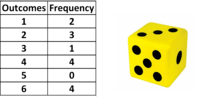
Jason rolls a die 14 times. What is the Experimental probability that he will roll a 2 ?
2/6
3/6
3/14
1/6
3.
MULTIPLE CHOICE QUESTION
1 min • 1 pt
Jason rolls a die 14 times.What is the Experimental probability that he will roll a 2?
2/6
3/6
3/14
2/14
4.
MULTIPLE CHOICE QUESTION
1 min • 1 pt

A class quiz has 5 True/False questions. The correct answers are T, T, F, F, and T, in that order. Brandon answered the questions randomly and is now wondering if he will pass the quiz. He needs to have at least 3 correct answers. Brandon used a calculator to generate random numbers from 1 to 100. He let odd numbers stand for True and even numbers stand for False. He recorded the results in the table. What is the experimental probability that John passed the quiz? Use the chart to answer the question.
1/4
1/3
1/2
1
5.
FILL IN THE BLANKS QUESTION
1 min • 1 pt

A number cube was rolled 20 times to represent 20 purchases. What is the experimental probability of receiving a 20% coupon? Write the probability as a decimal.
(a)
6.
MULTIPLE CHOICE QUESTION
1 min • 1 pt

Yesica has a bag containing colored beads. Her classmates take turns selecting one bead from the bag without looking, recording the color in the table, and replacing the bead. What is the experimental probability that a red bead is selected?
P(red) =
P(red) =
P(red) =
P(red) =
7.
MULTIPLE CHOICE QUESTION
1 min • 1 pt
A class quiz has 5 True/False questions. The correct answers are T, T, F, F, and T, in that order. Brandon answered the questions randomly and is now wondering if he will pass the quiz. He needs to have at least 3 correct answers. Brandon used a calculator to generate random numbers from 1 to 100. He let odd numbers stand for True and even numbers stand for False. He recorded the results in the table. What is the experimental probability that John passed the quiz? Use the chart to answer the question.
1/4
1/3
1/2
1

Access all questions and much more by creating a free account
Create resources
Host any resource
Get auto-graded reports

Continue with Google

Continue with Email

Continue with Microsoft
or continue with

%20(1).png)
Apple

Others
By signing up, you agree to our Terms of Service & Privacy Policy
Already have an account?

