
Our Sun
9th - 10th Grade
•15 Qs

Similar activities
LAST 2!
10th - 11th Grade
•20 Qs
SCIENCE 9
9th Grade
•14 Qs
Stages of photosythesis
7th - 11th Grade
•20 Qs
Atoms
8th - 9th Grade
•20 Qs
Concept_Y9
9th Grade
•14 Qs
PERIODIC CLASSIFICATION OF ELEMENTS
10th Grade
•20 Qs
Cell Respiration
9th Grade
•15 Qs
7C Particles - ECAM
7th - 10th Grade
•20 Qs
Our Sun

Quiz
•
Science
•
9th - 10th Grade
•
Practice Problem
•
Hard
+1
Standards-aligned

Charles Martinez
FREE Resource

Enhance your content in a minute
15 questions
Show all answers
1.
MULTIPLE CHOICE QUESTION
30 sec • 1 pt
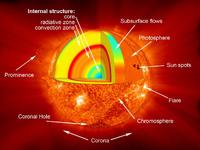
How long does it take energy to pass through the radiation zone?
2.
MULTIPLE CHOICE QUESTION
30 sec • 1 pt
In which area of the sun does gas rise as it heats up, then fall back down as it cools?
the core
the radiative zone
the convective zone
the corona
3.
MULTIPLE CHOICE QUESTION
30 sec • 1 pt
When we look at the sun, what layer are we viewing?
4.
MULTIPLE CHOICE QUESTION
30 sec • 1 pt
What layer of the sun's atmosphere gives the sun its "white halo" during a solar eclipse?
5.
MULTIPLE CHOICE QUESTION
30 sec • 1 pt
The particles of the corona extends into space for millions of kilometers and spreads into streams of electrically charged particles called:
6.
MULTIPLE CHOICE QUESTION
30 sec • 1 pt
Areas of gas on the sun's surface that are cooler than gases around them are called:
7.
MULTIPLE CHOICE QUESTION
30 sec • 1 pt
Huge loops of reddish gas that connect sunspots are called:
Access all questions and much more by creating a free account
Create resources
Host any resource
Get auto-graded reports

Continue with Google

Continue with Email

Continue with Classlink

Continue with Clever
or continue with

Microsoft
%20(1).png)
Apple

Others
Already have an account?
Similar Resources on Wayground
10 questions
Nutrición celular
Quiz
•
1st - 12th Grade
10 questions
CONVERGENT BOUNDARY
Quiz
•
10th Grade
15 questions
Y9 chemistry quiz on air and water
Quiz
•
7th - 10th Grade
10 questions
Our Future
Quiz
•
KG - 12th Grade
13 questions
Atomic Structure
Quiz
•
7th Grade - University
10 questions
Honey Bees
Quiz
•
9th - 12th Grade
10 questions
HANDWASHING FACT VS MYTH
Quiz
•
9th - 12th Grade
15 questions
Earth & Space....so far
Quiz
•
9th Grade
Popular Resources on Wayground
15 questions
Fractions on a Number Line
Quiz
•
3rd Grade
20 questions
Equivalent Fractions
Quiz
•
3rd Grade
25 questions
Multiplication Facts
Quiz
•
5th Grade
22 questions
fractions
Quiz
•
3rd Grade
20 questions
Main Idea and Details
Quiz
•
5th Grade
20 questions
Context Clues
Quiz
•
6th Grade
15 questions
Equivalent Fractions
Quiz
•
4th Grade
20 questions
Figurative Language Review
Quiz
•
6th Grade
Discover more resources for Science
10 questions
Exploring the Layers of the Earth

Interactive video
•
6th - 10th Grade
25 questions
Naming Ionic and Covalent Compounds
Quiz
•
9th Grade
14 questions
Natural Selection and Adaptation

Lesson
•
9th - 12th Grade
20 questions
Atomic Structure
Quiz
•
9th Grade
10 questions
Exploring the Ring of Fire: Volcanoes and Earthquakes
Interactive video
•
6th - 10th Grade
38 questions
Water Cycle and Groundwater
Quiz
•
9th - 12th Grade
10 questions
Exploring Spring and Neap Tides
Interactive video
•
6th - 10th Grade
15 questions
DNA and RNA review
Quiz
•
9th Grade