Evolution

Evolution

9th - 12th Grade

43 Qs

quiz-placeholder

Similar activities

UNIT 6 - NUCLEIC ACID & PROTEIN SYNTHESIS

UNIT 6 - NUCLEIC ACID & PROTEIN SYNTHESIS

11th Grade

45 Qs

GenBio finals reviewer part 2

GenBio finals reviewer part 2

11th Grade

48 Qs

Osmoregulation

Osmoregulation

10th - 11th Grade

43 Qs

Scientific Method, Community and Ecosystem Ecology

Scientific Method, Community and Ecosystem Ecology

9th Grade - University

43 Qs

DNA, RNA, Replication & Transcription

DNA, RNA, Replication & Transcription

9th - 12th Grade

40 Qs

EOC Review

EOC Review

10th Grade - University

42 Qs

Inheritance & DNA Review

Inheritance & DNA Review

9th Grade - University

48 Qs

Unit 10 Exam - Dermatology and Immunology

Unit 10 Exam - Dermatology and Immunology

9th - 12th Grade

40 Qs

Evolution

Evolution

Assessment

Quiz

Biology

9th - 12th Grade

Practice Problem

Hard

NGSS
MS-LS4-2, MS-LS4-3, MS-LS4-1

+4

Standards-aligned

Created by

Charles Martinez

FREE Resource

AI

Enhance your content in a minute

Add similar questions
Adjust reading levels
Convert to real-world scenario
Translate activity
More...

43 questions

Show all answers

1.

MULTIPLE CHOICE QUESTION

30 sec • 1 pt

How does embryology support the Theory of Evolution?

It shows that they have a common ancestor because of their similarities.
         I'm not sure.
Animals change over time. 

Tags

NGSS.MS-LS4-2

NGSS.MS-LS4-3

2.

MULTIPLE CHOICE QUESTION

30 sec • 1 pt

A change in the inherited characteristics of an organism over time is ________

evolution.
development.
growth.
ancestry.

Tags

NGSS.MS-LS4-1

NGSS.MS-LS4-2

NGSS.MS-LS4-4

3.

MULTIPLE CHOICE QUESTION

30 sec • 1 pt

The most recent ancestral form or species from which two different species evolved is known as ________________________.

a common ancestor.
an embryonic stage.
development.
evolution.

Tags

NGSS.MS-LS4-2

4.

MULTIPLE CHOICE QUESTION

30 sec • 1 pt

Media Image

In stage one (top row) of these embryos, most of the embryos________

look very similar.
have very different features.
show different stages of development.
have only a tail if they are non-human.

Tags

NGSS.MS-LS4-2

5.

MULTIPLE CHOICE QUESTION

30 sec • 1 pt

Media Image

In the the third embryonic stage (bottom row), mammal embryos _____

have more characteristics in common with each other than with reptiles or birds.
are still hard to tell from reptiles and birds.
have the same features as fish, reptiles, and birds.
do not have tails.

Tags

NGSS.MS-LS4-2

NGSS.MS-LS4-3

6.

MULTIPLE CHOICE QUESTION

30 sec • 1 pt

Media Image

In stage 2 (middle row) fish embryos _________

are very different bird and mammal embryos.
are still very similar to bird and mammal embryos.
show arm and leg buds.
are the only embryos with tails.

Tags

NGSS.MS-LS4-2

7.

MULTIPLE CHOICE QUESTION

30 sec • 1 pt

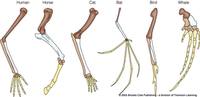
Media Image

What type of evidence is represented in the picture above:

Fossils

Vestigial Structures

DNA

Homologous Structures

Tags

NGSS.MS-LS4-2

Create a free account and access millions of resources

Create resources

Host any resource

Get auto-graded reports

Google

Continue with Google

Email

Continue with Email

Classlink

Continue with Classlink

Clever

Continue with Clever

or continue with

Microsoft

Microsoft

Apple

Apple

Others

Others

Already have an account?