
Unit 4 Test Review
Authored by Victoria Burton
Science
11th - 12th Grade
NGSS covered
Used 179+ times


AI Actions
Add similar questions
Adjust reading levels
Convert to real-world scenario
Translate activity
More...
About
This quiz comprehensively assesses high school environmental science concepts focusing on Earth systems and atmospheric science. The questions evaluate students' understanding of atmospheric layers and their characteristics, global circulation patterns and their relationship to biome distribution, plate tectonics and geological processes, climate phenomena including El Niño effects, and the fundamental drivers of Earth's seasons and weather patterns. Students must demonstrate mastery of complex interconnected systems, requiring them to analyze diagrams, interpret data tables, and apply scientific reasoning to explain cause-and-effect relationships between atmospheric conditions, ocean currents, and geological processes. The material demands sophisticated spatial thinking skills as students work with latitude-based phenomena, three-dimensional atmospheric models, and global-scale circulation patterns that drive both short-term weather and long-term climate. Created by Victoria Burton, a Science teacher in US who teaches grade 11, 12. This comprehensive review quiz serves as an excellent formative assessment tool to gauge student readiness before a major unit exam on Earth systems. Teachers can deploy this as a homework assignment to help students identify knowledge gaps, use it as a collaborative review activity where students work through challenging questions in pairs, or implement it as a warm-up assessment spread across multiple class periods. The quiz's structure makes it particularly effective for differentiated instruction, allowing teachers to assign specific question sets based on individual student needs or to create targeted remediation groups. The content aligns with Next Generation Science Standards HS-ESS2-4 (plate tectonics and large-scale system interactions), HS-ESS2-2 (climate and weather patterns), and HS-ESS3-5 (human impact on environment and climate), providing robust preparation for standardized assessments while reinforcing the quantitative analysis skills essential for advanced environmental science coursework.
Content View
Student View
25 questions
Show all answers
1.
MULTIPLE CHOICE QUESTION
30 sec • 1 pt
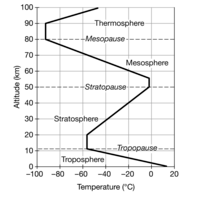
The graph shows the altitude and temperature for different layers of Earth’s atmosphere. Based on the diagram, which of the following identifies a characteristic of the atmosphere between the stratopause and the tropopause?
Cloud formation occurs in the stratosphere.
The warmest air is found in the mesosphere.
The ozone layer is in the stratosphere.
The troposphere is the closest layer to the sun.
Tags
NGSS.MS-ESS2-5
2.
MULTIPLE CHOICE QUESTION
30 sec • 1 pt
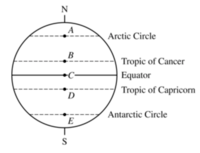
Which latitude shown on the diagram above experiences 24 hours of daylight on December 21?
A
B
C
D
E
Tags
NGSS.MS-ESS1-1
3.
MULTIPLE CHOICE QUESTION
30 sec • 1 pt
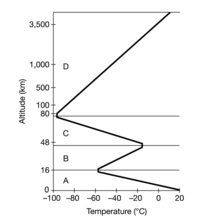
Which of the following correctly characterizes one of Earth’s atmospheric layers?f
Layer A is the stratosphere, where meteors are found.
Layer B is the troposphere, where weather occurs.
Layer C is the stratosphere, where the ozone layer is found.
Layer D is the thermosphere, where auroras are found.
Tags
NGSS.MS-ESS2-5
4.
MULTIPLE CHOICE QUESTION
30 sec • 1 pt
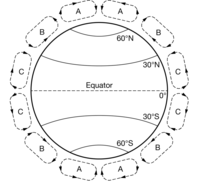
The diagram is an illustration of global atmospheric circulation. Which of the following is a biome found at 30°N and 30°S as seen in the diagram?
Rain forests
Tundras
Coniferous forests
Deserts
Tags
NGSS.MS-ESS2-6
5.
MULTIPLE CHOICE QUESTION
30 sec • 1 pt
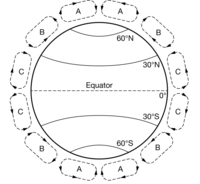
The diagram is an illustration of global atmospheric circulation. Which of the following is the source of energy driving the circulation pattern labeled C in the diagram?
The Coriolis effect
Solar radiation
Earth's magnetic field
The spinning core of Earth
Tags
NGSS.MS-ESS2-6
6.
MULTIPLE CHOICE QUESTION
30 sec • 1 pt

The diagram is an illustration of global atmospheric circulation. Which of the following causes the air to rise high into the atmosphere in the areas labeled A, B, and C on the diagram?
El Niño circulation patterns
The rotation of Earth shifting the direction of the air upward
Warm, moist air that is less dense than the surrounding air
Rain shadows over mountain ridges
Tags
NGSS.MS-ESS2-6
7.
MULTIPLE CHOICE QUESTION
30 sec • 1 pt
Which of the following shows the approximate concentration of CO2 , N2 , and O2 in dry air?
CO2 - 78%, N2 - <1%, O2 - 21%
CO2 - 43%, N2 - <1%, O2 - 56%
CO2 - 10%, N2- 70%, O2 - 20%
CO2 - <1%, N2 - 78%, O2 - 21%


Access all questions and much more by creating a free account
Create resources
Host any resource
Get auto-graded reports

Continue with Google

Continue with Email

Continue with Microsoft
or continue with

%20(1).png)
Apple

Others
By signing up, you agree to our Terms of Service & Privacy Policy
Already have an account?


