
Types of Chemical Bonds

Types of Chemical Bonds

9th - 12th Grade

14 Qs

quiz-placeholder

Similar activities

Alcohols and Esters

Alcohols and Esters

10th Grade

14 Qs

pop quiz- chemistry

pop quiz- chemistry

12th Grade

10 Qs

Year 9 chemistry

Year 9 chemistry

9th Grade

19 Qs

Chapter 26 - Understanding Intermolecular Forces

Chapter 26 - Understanding Intermolecular Forces

11th Grade

10 Qs

Chemistry Regent - June 2013 Q31-40

Chemistry Regent - June 2013 Q31-40

9th - 12th Grade

10 Qs

Redox Balancing Practice (acid solution)

Redox Balancing Practice (acid solution)

10th - 12th Grade

10 Qs

LBC Chapter 6 (Lesson 33) Functional Groups

LBC Chapter 6 (Lesson 33) Functional Groups

9th - 12th Grade

11 Qs

Revision Organic

Revision Organic

12th Grade

16 Qs

Types of Chemical Bonds

Types of Chemical Bonds

Assessment

Quiz

Chemistry

9th - 12th Grade

Practice Problem

Medium

NGSS
HS-PS1-1, HS-PS1-2, MS-PS1-1

Standards-aligned

Created by

Nicholas Angell

Used 4K+ times

FREE Resource

AI

Enhance your content in a minute

Add similar questions
Adjust reading levels
Convert to real-world scenario
Translate activity
More...

14 questions

Show all answers

1.

MULTIPLE CHOICE QUESTION

30 sec • 1 pt
Media Image

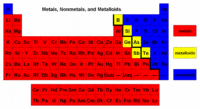
What elements generally make an ionic bond?

metal and nonmetal
2 or more nonmetals
metal
none of the above

Tags

NGSS.HS-PS1-1

NGSS.HS-PS1-2

2.

MULTIPLE CHOICE QUESTION

30 sec • 1 pt
Media Image

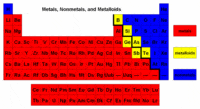
What elements generally make a covalent bond?

metal and nonmetal
2 or more nonmetals
metal
none of the above

Tags

NGSS.HS-PS1-1

3.

MULTIPLE CHOICE QUESTION

30 sec • 1 pt

Media Image

In chemical compounds, covalent bonds form when

the electronegativity difference between two atoms is very large.
electrons are completely transferred between two metals.
pairs of electrons are shared between two nonmetal atoms.
two nonmetal atoms are attracted to each other by opposite charges.

Tags

NGSS.HS-PS1-1

NGSS.HS-PS1-2

4.

MULTIPLE CHOICE QUESTION

30 sec • 1 pt

Media Image

An ionic bond forms when 

Valence electrons are shared
a sea of mobile electrons surround the cations
valence electrons are transferred between atoms
none of the above

Tags

NGSS.HS-PS1-2

5.

MULTIPLE CHOICE QUESTION

30 sec • 1 pt

Predict the bond that will form between Be and F.

Ionic
Covalent

Tags

NGSS.HS-PS1-1

NGSS.HS-PS1-2

6.

MULTIPLE CHOICE QUESTION

30 sec • 1 pt

Predict the bond that will form between Se and Cl.

Ionic
Covalent

Tags

NGSS.HS-PS1-1

NGSS.HS-PS1-2

7.

MULTIPLE CHOICE QUESTION

30 sec • 1 pt

Predict the bond that will form between Sr and S.

Ionic
Covalent

Tags

NGSS.HS-PS1-1

NGSS.HS-PS1-2

Create a free account and access millions of resources

Create resources

Host any resource

Get auto-graded reports

Google

Continue with Google

Email

Continue with Email

Classlink

Continue with Classlink

Clever

Continue with Clever

or continue with

Microsoft

Microsoft

Apple

Apple

Others

Others

Already have an account?




