
Fission and Fusion
9th - 12th Grade
•10 Qs

Similar activities
Unit 5: Chemical Reactions
10th - 11th Grade
•10 Qs
Enthalpy and Entropy
11th Grade
•15 Qs
EVALUACION GRADO 8° - III BIMESTRE- QUIMICA
1st - 10th Grade
•10 Qs
MOLE CONCEPT
10th Grade
•10 Qs
Química - Átomo e Radioatividade
10th Grade
•13 Qs
Intro to Stoichiometry
10th - 12th Grade
•15 Qs
alkene
10th - 12th Grade
•15 Qs
chapter 2 anions of HCl
12th Grade
•10 Qs
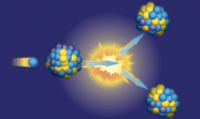
Fission and Fusion

Quiz
•
Chemistry
•
9th - 12th Grade
•
Practice Problem
•
Medium
Standards-aligned

Jessica Hughes
Used 49+ times
FREE Resource

Enhance your content in a minute
10 questions
Show all answers
1.
MULTIPLE CHOICE QUESTION
1 min • 1 pt
What process occurs when two smaller nuclei combine to form a larger nucleus, releasing large amounts of energy?
nuclear decay
nuclear transmutation
fission
fusion
Tags
NGSS.HS-PS1-8
2.
MULTIPLE CHOICE QUESTION
1 min • 1 pt
What occurs in a nuclear power plant when Uranium-235 splits into two smaller isotopes?
nuclear fusion
nuclear fission
a chemical reaction
a neutralization reaction
Tags
NGSS.HS-PS1-8
3.
MULTIPLE CHOICE QUESTION
1 min • 1 pt
What is the difference between fusion and fission?
Fusion combines large nuclei, while fission combines small nuclei.
Fusion combines small nuclei, while fission combines large nuclei.
Fusion combines large nuclei, while fission splits small nuclei.
Fusion combines small nuclei, while fission splits large nuclei.
Tags
NGSS.HS-PS1-8
4.
MULTIPLE CHOICE QUESTION
1 min • 1 pt
Of the following reactions, which is a fusion reaction?
carbon-14 decaying into nitrogen-14 and a beta particle
uranium-235 absorbing a neutron and splitting into xenon-140, strontium-94, and two neutrons
curium-246 combining with carbon-12 to form nobelium-254 and four neutrons
hydrochloric acid combining with sodium hydroxide to form a salt and water
Tags
NGSS.HS-PS1-8
5.
MULTIPLE CHOICE QUESTION
1 min • 1 pt
Where does the energy released in a nuclear reaction come from?
electrons
chemical bonds
positrons
the binding energy of the nucleus
Tags
NGSS.HS-PS1-8
6.
MULTIPLE CHOICE QUESTION
1 min • 1 pt

The diagram shows a nuclear reaction.
What type of reaction is shown in the diagram?
fusion, because the reaction released energy
fission, because the reaction absorbed energy
fusion, because the reaction formed heavier nuclei
fission, because the reaction formed lighter nuclei
Tags
NGSS.HS-PS1-8
7.
MULTIPLE CHOICE QUESTION
1 min • 1 pt

The diagram shows a nuclear reaction.
What type of reaction is shown in the diagram?
fusion, because the reaction released energy
fission, because the reaction absorbed energy
fusion, because the reaction formed heavier nuclei
fission, because the reaction formed lighter nuclei
Tags
NGSS.HS-PS1-8


Access all questions and much more by creating a free account
Create resources
Host any resource
Get auto-graded reports

Continue with Google

Continue with Email

Continue with Classlink

Continue with Clever
or continue with

Microsoft
%20(1).png)
Apple

Others
Already have an account?
Similar Resources on Wayground
10 questions
Evaluación de Entrada de Química 4to Sec
Quiz
•
10th Grade
15 questions
Reactions of Acids and Bases
Quiz
•
9th Grade
11 questions
Electrostatic Basics Inv 1&2 Review
Quiz
•
8th - 10th Grade
15 questions
History of atomic theory by Berlyn Amano
Quiz
•
11th Grade
15 questions
Formative Test : C5 Chemical Bonds
Quiz
•
6th - 12th Grade
10 questions
Chemistry Regent - June 2013 Q31-40
Quiz
•
9th - 12th Grade
10 questions
Redox Balancing Practice (acid solution)
Quiz
•
10th - 12th Grade
10 questions
Acid-Base
Quiz
•
11th - 12th Grade
Popular Resources on Wayground
15 questions
Fractions on a Number Line
Quiz
•
3rd Grade
20 questions
Equivalent Fractions
Quiz
•
3rd Grade
25 questions
Multiplication Facts
Quiz
•
5th Grade
54 questions
Analyzing Line Graphs & Tables
Quiz
•
4th Grade
22 questions
fractions
Quiz
•
3rd Grade
20 questions
Main Idea and Details
Quiz
•
5th Grade
20 questions
Context Clues
Quiz
•
6th Grade
15 questions
Equivalent Fractions
Quiz
•
4th Grade
Discover more resources for Chemistry
20 questions
Types of Chemical Reactions
Quiz
•
9th - 12th Grade
10 questions
Formative 3BC: Ionic v Covalent Bonds
Quiz
•
9th Grade
10 questions
Exploring Stoichiometry Concepts

Interactive video
•
6th - 10th Grade
20 questions
Mixed Bonding Naming
Quiz
•
9th Grade
20 questions
Naming & Writing Chemical Formulas
Quiz
•
10th Grade
20 questions
Chemical Reactions
Quiz
•
9th Grade
20 questions
Practice: E-Con, Orbital Notation, Noble Gas Notation
Quiz
•
10th Grade
20 questions
Covalent Bonding
Quiz
•
10th Grade