
AP physics 1 Uniform Circular Motion
9th - 12th Grade
•22 Qs

Similar activities
2018年科学概念复习(物理篇)
1st - 12th Grade
•17 Qs
Sc Physics Paper 1.2
7th - 9th Grade
•20 Qs
Methods of producing induced emf
12th Grade
•17 Qs
Cinemática 1
1st - 12th Grade
•19 Qs
Il Movimento
12th Grade
•20 Qs
Electricitat i circuits
9th Grade
•18 Qs
Física: Uso Comprensivo del Conocimiento Científico
10th Grade
•19 Qs
Grade 9 Pressure
9th Grade
•20 Qs

AP physics 1 Uniform Circular Motion

Quiz
•
Physics
•
9th - 12th Grade
•
Practice Problem
•
Medium
+4
Standards-aligned
Used 220+ times
FREE Resource
About this resource
This quiz comprehensively covers uniform circular motion and universal gravitation, fundamental topics in AP Physics 1 appropriate for grades 11-12. The questions assess students' understanding of centripetal force, centripetal acceleration, tangential velocity, and gravitational relationships through both conceptual reasoning and mathematical problem-solving. Students must demonstrate mastery of key formulas including F = mv²/r for centripetal force, a = v²/r for centripetal acceleration, and F = Gm₁m₂/r² for gravitational force. The content requires students to understand that centripetal acceleration results from constant directional changes toward the center of circular motion, that velocity remains tangent to the circular path, and that gravitational force follows an inverse square relationship with distance. Students need strong algebraic skills to manipulate these equations and conceptual understanding to predict motion patterns and force directions in various circular motion scenarios. This quiz was created by a classroom teacher who designed it for students studying AP Physics 1 in grades 9-12. The assessment serves multiple instructional purposes, functioning effectively as a comprehensive review before unit exams, formative assessment during instruction, or homework to reinforce problem-solving techniques. Teachers can use individual questions as warm-up problems to activate prior knowledge or deploy the entire quiz to gauge student readiness for advanced circular motion applications. The varied question formats—from direct calculations to conceptual predictions about motion paths—allow educators to identify specific areas where students need additional support. This quiz aligns with NGSS HS-PS2-1 (analyzing data to support claims about forces during interactions) and supports the mathematical practices emphasized in AP Physics 1, particularly the ability to apply mathematical routines to physical situations and connect mathematical representations to physical phenomena.
See more

Enhance your content in a minute
22 questions
Show all answers
1.
MULTIPLE CHOICE QUESTION
2 mins • 1 pt
Calculate the mass of an object if it took 20 N of force to rotate it in a circle with a radius of 2 meters with a velocity of 4 m/s
Tags
NGSS.MS-PS2-2
2.
MULTIPLE CHOICE QUESTION
2 mins • 1 pt

Why do objects experience centripetal acceleration?
Tags
NGSS.HS-PS2-1
3.
MULTIPLE CHOICE QUESTION
2 mins • 1 pt

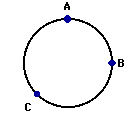
At the instant shown in the diagram, the car's centripetal acceleration is directed-
toward E
toward N
toward W
clockwise
Tags
NGSS.HS-PS2-1
4.
MULTIPLE CHOICE QUESTION
1 min • 1 pt
The velocity is always _____ to the line of a circle.
5.
MULTIPLE CHOICE QUESTION
2 mins • 1 pt

If the radius of the string is .3 meters long and the stopper makes 5 revolutions per second, what is the speed of the stopper? (Hint: C=2πr)
Tags
NGSS.MS-PS3-1
NGSS.MS-PS3-5
6.
MULTIPLE CHOICE QUESTION
1 min • 1 pt
If a ball is swinging at the end of a rope and the rope is suddenly cut, assuming there is no gravity, what best describes the path it will take?
It will fly in a straight line forward from where it was cut
It will fly in a curved line away from the circle
It will fly inward toward the circle

7.
MULTIPLE CHOICE QUESTION
2 mins • 1 pt
A toy train moves in a circular track with a velocity of 2.2 m/s, the axis of rotation is 1.8 m. What is its centripetal acceleration?
1.22 m/s2
0.81 m/s2
2.69 m/s2
1.47 m/s2
Access all questions and much more by creating a free account
Create resources
Host any resource
Get auto-graded reports

Continue with Google

Continue with Email

Continue with Classlink

Continue with Clever
or continue with

Microsoft
%20(1).png)
Apple

Others
Already have an account?
Similar Resources on Wayground
18 questions
QUANG HỌC CƠ BẢN PHY11
Quiz
•
11th Grade
18 questions
Newton i zasady dynamiki
Quiz
•
9th - 12th Grade
18 questions
Difrakcija
Quiz
•
12th Grade
17 questions
Fisika
Quiz
•
9th Grade
20 questions
Quiz on Electric Charge, Force, Field and Flux
Quiz
•
9th - 12th Grade
20 questions
Kemagnetan
Quiz
•
12th Grade
20 questions
THE ATOM
Quiz
•
9th Grade
17 questions
Rõhk
Quiz
•
KG - University
Popular Resources on Wayground
15 questions
Fractions on a Number Line
Quiz
•
3rd Grade
20 questions
Equivalent Fractions
Quiz
•
3rd Grade
25 questions
Multiplication Facts
Quiz
•
5th Grade
54 questions
Analyzing Line Graphs & Tables
Quiz
•
4th Grade
22 questions
fractions
Quiz
•
3rd Grade
20 questions
Main Idea and Details
Quiz
•
5th Grade
20 questions
Context Clues
Quiz
•
6th Grade
15 questions
Equivalent Fractions
Quiz
•
4th Grade
Discover more resources for Physics
27 questions
Simple Machines and Mechanical Advantage Quiz
Quiz
•
9th Grade
16 questions
Coulomb's Law
Quiz
•
11th Grade
10 questions
Understanding Heat, Thermal Energy, and Temperature

Interactive video
•
9th - 10th Grade
10 questions
Newton's Laws of Motion
Quiz
•
10th Grade
10 questions
unit 10 -- electric forces and fields

Lesson
•
9th - 12th Grade
21 questions
Diffraction, Reflection, Refraction
Quiz
•
9th - 12th Grade
15 questions
Position vs. Time and Velocity vs. Time Graphs
Quiz
•
10th - 12th Grade
10 questions
Types of Chemical Reactions
Quiz
•
10th Grade