
Circular and Torque
10th Grade - University
•16 Qs

Similar activities
QUIZ FISIKA 2
University
•20 Qs
01. Sistemas y Componentes
University
•13 Qs
REMEDIAL TERMODINAMIKA
11th Grade
•12 Qs
Listrik Arus Bolak Balik
12th Grade
•15 Qs
Ch1: Measurement, Estimating
University
•16 Qs
Vectors Physics NEET
11th Grade
•12 Qs
NCUK IFY Physics - G) Work and Energy
12th Grade
•17 Qs
Diagnóstico
10th Grade
•14 Qs
Circular and Torque

Quiz
•
Physics
•
10th Grade - University
•
Practice Problem
•
Hard
Standards-aligned

Charles Martinez
FREE Resource

Enhance your content in a minute
16 questions
Show all answers
1.
MULTIPLE CHOICE QUESTION
3 mins • 1 pt

What force does not cause any torque?
2.
MULTIPLE CHOICE QUESTION
3 mins • 1 pt

Does a bridge anchored resting on two pillars have any torque?
Tags
NGSS.HS-PS2-1
NGSS.HS-PS2-3
3.
MULTIPLE CHOICE QUESTION
3 mins • 1 pt

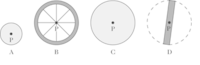
Which of these has the greatest centripetal acceleration?
4.
MULTIPLE CHOICE QUESTION
3 mins • 1 pt
The rotational equivalent to d (distance), v (velocity) and a (acceleration) are?
m, m/s, m/s2
θ, ω, α
x, x/t, α
μ, Σ, τ
5.
MULTIPLE CHOICE QUESTION
3 mins • 1 pt
How do you get the maximum torque?
6.
MULTIPLE CHOICE QUESTION
3 mins • 1 pt

A solid metal bar is at rest on a horizontal frictionless surface. It is free to rotate about a vertical axis at the left end. The figures show forces of different magnitudes that are exerted on the bar at different locations. In which case does the bar's angular speed about the axis increase at the fastest rate?
7.
MULTIPLE CHOICE QUESTION
3 mins • 1 pt
When a rigid object rotates about a fixed axis, what is true about all the points in the object?
Access all questions and much more by creating a free account
Create resources
Host any resource
Get auto-graded reports

Continue with Google

Continue with Email

Continue with Classlink

Continue with Clever
or continue with

Microsoft
%20(1).png)
Apple

Others
Already have an account?
Similar Resources on Wayground
15 questions
PHYSICS 1 - 2ND QUARTER CONCEPT REVIEWER
Quiz
•
12th Grade
15 questions
Campo eléctrico, ley de Coulomb y potencial eléctrico
Quiz
•
11th - 12th Grade
20 questions
FREE FALL
Quiz
•
9th - 10th Grade
20 questions
PAS FISIKA KELAS XI MIA
Quiz
•
11th Grade
20 questions
Física Putumayo. Jonathan Godoy
Quiz
•
10th Grade
18 questions
Listrik Bolak-balik
Quiz
•
12th Grade
21 questions
Střídavý proud 1ABPS
Quiz
•
9th - 12th Grade
19 questions
Standing Waves
Quiz
•
11th - 12th Grade
Popular Resources on Wayground
15 questions
Fractions on a Number Line
Quiz
•
3rd Grade
20 questions
Equivalent Fractions
Quiz
•
3rd Grade
25 questions
Multiplication Facts
Quiz
•
5th Grade
22 questions
fractions
Quiz
•
3rd Grade
20 questions
Main Idea and Details
Quiz
•
5th Grade
20 questions
Context Clues
Quiz
•
6th Grade
15 questions
Equivalent Fractions
Quiz
•
4th Grade
20 questions
Figurative Language Review
Quiz
•
6th Grade
Discover more resources for Physics
18 questions
Universal Law of Gravitation

Lesson
•
11th Grade
20 questions
Potential and Kinetic Energy
Quiz
•
9th - 12th Grade
34 questions
Energy Review
Quiz
•
9th - 12th Grade
14 questions
Bill Nye Waves

Interactive video
•
9th - 12th Grade
24 questions
Reflection, Refraction & Diffraction
Quiz
•
6th - 12th Grade
14 questions
Work and Energy intro
Interactive video
•
8th - 10th Grade