
Physics Harmonic Motion
12th Grade
•10 Qs

Similar activities
8.04: Lenses: Power of a Lens
11th - 12th Grade
•10 Qs
Hubble Telescope Picture
9th - 12th Grade
•10 Qs
Electromagnetic induction 电磁感应
10th - 12th Grade
•10 Qs
5.2 SEMICONDUCTOR DIODE
12th Grade
•15 Qs
Capacitance 2
12th Grade
•10 Qs
Work Education (Electricity)
6th - 12th Grade
•10 Qs
S3 PHY GRAVITATIONAL FIELD
9th - 12th Grade
•10 Qs
Energy Calculations
9th - 12th Grade
•10 Qs
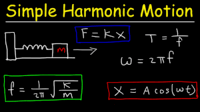
Physics Harmonic Motion

Quiz
•
Physics
•
12th Grade
•
Practice Problem
•
Hard
Standards-aligned

Charles Martinez
FREE Resource

Enhance your content in a minute
10 questions
Show all answers
1.
MULTIPLE CHOICE QUESTION
30 sec • 1 pt
When is a pendulum in simple harmonic motion?
Never
All the time
only at large angles
only at small angles
2.
MULTIPLE CHOICE QUESTION
30 sec • 1 pt
When is the pendulum at maximum velocity
At its lowest point
At its highest point
It moves at a constant velocity
It is at rest
3.
MULTIPLE CHOICE QUESTION
30 sec • 1 pt
What is the definition of SHM?
periodic motion without loss of energy in which the acceleration of a body is directly proportional to its displacement and is directed towards the equilibrium position but in opposite direction of the displacement.
periodic motion without loss of energy in which the acceleration is directly proportional to its velocity and is directed towards the equilibrium position but in opposite direction of the velocity.
periodic motion without loss of energy in which the acceleration of a body is inversely proportional to its displacement
periodic motion without loss of energy in which the angular frequency is directly proportional to its displacement and is directed towards the equilibrium position but in opposite direction of the displacement.
4.
MULTIPLE CHOICE QUESTION
30 sec • 1 pt
Position at which the body would come to rest if it were to lose all of its energy refers to
equilibrium position
maximum displacement / amplitude
periodic position
good position
5.
MULTIPLE CHOICE QUESTION
30 sec • 1 pt
The number of cycles or oscillation made in one second is defined as
time taken
period
frequency
amplitude
Tags
NGSS.HS-PS4-1
6.
MULTIPLE CHOICE QUESTION
30 sec • 1 pt
Given an expression of x = 10 sin (0.25πt) where x in cm, t in second. Which of these answers are true?
the frequency is 0.125 Hz
the amplitude is 10 m
the angular frequency is 0.125 rad s-1
at t = 0, x = 10 cm
Tags
NGSS.HS-PS4-1
7.
MULTIPLE CHOICE QUESTION
30 sec • 1 pt
Given an expression of a SHM
x = 10 sin (11.4t). Calculate the time taken when x=10 cm for the 1st time
0.138 s
1.24 s
11.11 s
0.79 s
Tags
NGSS.HS-PS4-1

Access all questions and much more by creating a free account
Create resources
Host any resource
Get auto-graded reports

Continue with Google

Continue with Email

Continue with Classlink

Continue with Clever
or continue with

Microsoft
%20(1).png)
Apple

Others
Already have an account?
Similar Resources on Wayground
10 questions
Welcome to FSKS 123
Quiz
•
12th Grade
12 questions
Classification of particles
Quiz
•
12th Grade - University
12 questions
Generation of Energy(Transformer) Cikgu Sakinah
Quiz
•
6th - 12th Grade
10 questions
Physics - 1.1 - The Science of Physics
Quiz
•
9th Grade - University
13 questions
Capacitors
Quiz
•
12th Grade
15 questions
Momentum and Impulse Review
Quiz
•
11th - 12th Grade
10 questions
BEST PRACTICE Friction
Quiz
•
10th - 12th Grade
15 questions
Get Ready for Science
Quiz
•
KG - 12th Grade
Popular Resources on Wayground
15 questions
Fractions on a Number Line
Quiz
•
3rd Grade
20 questions
Equivalent Fractions
Quiz
•
3rd Grade
25 questions
Multiplication Facts
Quiz
•
5th Grade
22 questions
fractions
Quiz
•
3rd Grade
20 questions
Main Idea and Details
Quiz
•
5th Grade
20 questions
Context Clues
Quiz
•
6th Grade
15 questions
Equivalent Fractions
Quiz
•
4th Grade
20 questions
Figurative Language Review
Quiz
•
6th Grade
