
Plate Boundaries & Surface Features
6th Grade
•28 Qs

Similar activities
Atoms
5th - 8th Grade
•24 Qs
Unit 10: Exploring the Universe Chapter Review
5th - 8th Grade
•25 Qs
CELLS
6th - 8th Grade
•25 Qs
Body Movement Class 6
6th - 7th Grade
•25 Qs
Unit 2 Lesson 3 (7th Science)
6th - 8th Grade
•23 Qs
honors science - final exam
6th - 8th Grade
•23 Qs
Science Waves! (Helpful Study for Benchmarks upcoming!)
6th Grade
•24 Qs
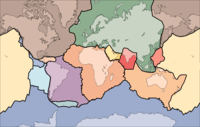
Plate Boundaries & Surface Features

Quiz
•
Science
•
6th Grade
•
Practice Problem
•
Hard
Standards-aligned

Charles Martinez
FREE Resource

Enhance your content in a minute
28 questions
Show all answers
1.
MULTIPLE CHOICE QUESTION
30 sec • 1 pt

Scientists think the continents once formed a large, single landmass that broke apart, and the continents slowly drifted to their present locations. What is the name given to this claim?
continental slope
continental shelf
continental drift
continental rise
Tags
NGSS.MS-ESS2-3
2.
MULTIPLE CHOICE QUESTION
30 sec • 1 pt
Florida is not close the edge of a tectonic plate. Therefore, which one of the following features does not exist in or beneath Florida?
tectonic plate boundary
tectonic plate
mantle
crust
3.
MULTIPLE CHOICE QUESTION
30 sec • 1 pt
The Red Sea formed as the African Plate moved apart from the Arabian Plate. Which type of boundary was involved in the formation of the Red Sea?
convergent boundary
stationary boundary
divergent boundary
transform boundary
Tags
NGSS.MS-ESS2-2
NGSS.MS-ESS2-3
4.
MULTIPLE CHOICE QUESTION
30 sec • 1 pt
The Rocky Mountains formed when the Pacific plate collided with the North American plate. Which of the following terms describes this process?
convergent boundary
transform boundary
divergent boundary
ridge push
Tags
NGSS.MS-ESS2-2
NGSS.MS-ESS2-3
5.
MULTIPLE CHOICE QUESTION
30 sec • 1 pt
The asthenosphere is the part of the mantle on which the tectonic plates move. Which of these statements best describes a characteristic of the asthenosphere that allows the tectonic plates to move?
It is porous.
It is permeable.
It is rigid.
It is soft.
6.
MULTIPLE CHOICE QUESTION
30 sec • 1 pt
A plate boundary is a place where two tectonic plates meet. There are several types of tectonic plate boundaries. Which statement below shows the correct definition of a tectonic plate boundary?
At a divergent boundary, one plate sinks under another plate.
At a convergent boundary, plates slide past each other.
At a transform boundary, plates move apart.
At a divergent boundary, plates separate.
7.
MULTIPLE CHOICE QUESTION
30 sec • 1 pt
Convection currents in the mantle contribute to tectonic plate movement. What is a convection current?
the transfer of energy by direct contact
the transfer of energy by the movement of matter
the transfer of energy through a solid, such as the Earth’s crust
the transfer of energy from a region of lower temperature to a region of higher temperature
Tags
NGSS.MS-ESS2-3




Access all questions and much more by creating a free account
Create resources
Host any resource
Get auto-graded reports

Continue with Google

Continue with Email

Continue with Classlink

Continue with Clever
or continue with

Microsoft
%20(1).png)
Apple

Others
Already have an account?
Similar Resources on Wayground
24 questions
Rocks and Minerals 1
Quiz
•
6th Grade
24 questions
Tectonic Plate Movement
Quiz
•
6th Grade
24 questions
Natural Hazards Quiz
Quiz
•
6th - 8th Grade
25 questions
Earth Science CSA Practice
Quiz
•
6th - 8th Grade
26 questions
Origins of the Universe Review
Quiz
•
6th Grade
33 questions
Midterm Review
Quiz
•
6th Grade
30 questions
Earthś Layers and Continental Drift
Quiz
•
6th - 8th Grade
23 questions
Trisk
Quiz
•
6th Grade
Popular Resources on Wayground
15 questions
Fractions on a Number Line
Quiz
•
3rd Grade
20 questions
Equivalent Fractions
Quiz
•
3rd Grade
25 questions
Multiplication Facts
Quiz
•
5th Grade
54 questions
Analyzing Line Graphs & Tables
Quiz
•
4th Grade
22 questions
fractions
Quiz
•
3rd Grade
20 questions
Main Idea and Details
Quiz
•
5th Grade
20 questions
Context Clues
Quiz
•
6th Grade
15 questions
Equivalent Fractions
Quiz
•
4th Grade
Discover more resources for Science
20 questions
Cell Organelles and Functions
Quiz
•
6th - 8th Grade
33 questions
Grade 6 Quarter 3 PMA 5 Review
Quiz
•
6th - 8th Grade
20 questions
Rocks and The Rock Cycle
Quiz
•
6th Grade
20 questions
Thermal Energy - Heat Transfer
Quiz
•
6th Grade
10 questions
Exploring the Rock Cycle: Types and Formation

Interactive video
•
6th - 8th Grade
10 questions
Exploring the Layers of the Earth
Interactive video
•
6th - 10th Grade
15 questions
Punnett Squares
Quiz
•
6th Grade
10 questions
Exploring the Rock Cycle
Interactive video
•
6th - 8th Grade