
Transcription and Translation
Biology
9th - 11th Grade
NGSS covered
Used 1K+ times


AI Actions
Add similar questions
Adjust reading levels
Convert to real-world scenario
Translate activity
More...
About
This quiz focuses on transcription and translation, the fundamental processes of gene expression in molecular biology. The questions assess understanding at a high school level, appropriate for grades 9-11, covering how genetic information flows from DNA to RNA to proteins according to the central dogma of molecular biology. Students need to understand the structural differences between DNA and RNA, including the bases used in each nucleic acid, and master the mechanics of transcription where DNA serves as a template for mRNA synthesis. They must also grasp translation concepts including how codons specify amino acids, the role of tRNA in delivering amino acids to ribosomes, and the significance of start and stop codons in protein synthesis. The quiz requires students to apply base-pairing rules, interpret genetic code tables, and distinguish between inherited traits versus acquired characteristics. This quiz was created by a classroom teacher who designed it for students studying molecular biology in grades 9-11. The comprehensive question set serves multiple instructional purposes, working effectively as a formative assessment tool to gauge student understanding before moving to more advanced genetics topics, or as targeted practice following lessons on gene expression. Teachers can deploy this quiz as a warm-up activity to activate prior knowledge, assign it as homework to reinforce classroom learning, or use it for review sessions before unit exams. The variety of question formats, from direct recall of processes to application of transcription rules with specific DNA sequences, allows educators to identify specific knowledge gaps and adjust instruction accordingly. This assessment aligns with standards HS-LS1-1 (constructing explanations for how DNA codes for proteins) and HS-LS3-1 (developing models to explain inheritance patterns), supporting students in building essential foundational knowledge for advanced biology coursework.
Content View
Student View
25 questions
Show all answers
1.
MULTIPLE CHOICE QUESTION
20 sec • 1 pt
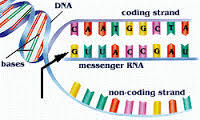
How would the DNA sequence GCTATA be transcribed to mRNA?
Tags
NGSS.HS-LS1-1
2.
MULTIPLE CHOICE QUESTION
1 min • 1 pt

The process by which the genetic code of DNA is copied into a strand of RNA is called
3.
MULTIPLE CHOICE QUESTION
1 min • 1 pt

In messenger RNA, each codon specifies a particular
4.
MULTIPLE CHOICE QUESTION
30 sec • 1 pt

Which of the following statements about the genetic code is true?
5.
MULTIPLE CHOICE QUESTION
1 min • 1 pt

The process of making proteins on the ribosome based on instructions from messenger RNA is called
6.
MULTIPLE CHOICE QUESTION
30 sec • 1 pt
What would the mRNA strand be after transcription of this DNA strand?
ATC
7.
MULTIPLE CHOICE QUESTION
1 min • 1 pt
DNA codes for (or makes) a _______________?
Tags
NGSS.HS-LS1-1

Access all questions and much more by creating a free account
Create resources
Host any resource
Get auto-graded reports

Continue with Google

Continue with Email

Continue with Classlink

Continue with Clever
or continue with

Microsoft
%20(1).png)
Apple

Others
Already have an account?
Similar Resources on Wayground

20 questions
DNA,RNA, ATP

Quiz
•
11th Grade
20 questions
Mitose-Meiose
Quiz
•
9th - 11th Grade
20 questions
Sejarah-Peranan virus
Quiz
•
9th - 12th Grade
20 questions
Bio Revision B5 Biological Molecules
Quiz
•
11th Grade
20 questions
Cell as the Basic Unit of Life
Quiz
•
7th - 11th Grade
20 questions
HAEC KS4 Biology 2a: Organisation
Quiz
•
10th Grade
20 questions
Review Quiz in Science10
Quiz
•
10th Grade
20 questions
RY - Biologi XI
Quiz
•
11th Grade
Popular Resources on Wayground
7 questions
History of Valentine's Day

Interactive video
•
4th Grade
15 questions
Fractions on a Number Line
Quiz
•
3rd Grade
20 questions
Equivalent Fractions
Quiz
•
3rd Grade
25 questions
Multiplication Facts
Quiz
•
5th Grade
22 questions
fractions
Quiz
•
3rd Grade
15 questions
Valentine's Day Trivia
Quiz
•
3rd Grade
20 questions
Main Idea and Details
Quiz
•
5th Grade
20 questions
Context Clues
Quiz
•
6th Grade
Discover more resources for Biology
22 questions
Human Body Systems Overview
Quiz
•
9th Grade
25 questions
photosynthesis and cellular respiration
Quiz
•
9th Grade
15 questions
African American Impact in the 1980s
Quiz
•
9th Grade
20 questions
Symbiotic Relationships
Quiz
•
9th Grade
20 questions
Food Chains and Food Webs
Quiz
•
7th - 12th Grade
10 questions
Exploring Food Webs and Energy Pyramids
Interactive video
•
6th - 10th Grade
20 questions
Cladogram Practice
Quiz
•
10th Grade
20 questions
CFA #2 Unit 3 Human Body Systems (21.2 & 21.3)
Quiz
•
9th - 12th Grade