
Hooke's Law and Elastic Potential Energy
Authored by Lisa Thompson
Science
8th Grade
NGSS covered
Used 1+ times


AI Actions
Add similar questions
Adjust reading levels
Convert to real-world scenario
Translate activity
More...
Content View
Student View
25 questions
Show all answers
1.
MULTIPLE CHOICE QUESTION
1 min • 1 pt
WHEN AN ARCHER BENDS A BOW, WHAT TYPE OF ENERGY INCREASES IN THE BOW?
GRAVITATIONAL
ELASTIC
KINETIC
THERMAL
2.
MULTIPLE CHOICE QUESTION
1 min • 1 pt

A spring with spring constant 16 N/m is compressed by 0.5 m. How much energy is stored in the spring?
1 J
0.25 J
2 J
16 J
Tags
NGSS.MS-PS3-2
3.
MULTIPLE CHOICE QUESTION
1 min • 1 pt
The equation for spring force is
(Hint - Hooke's Law)
Fsp = mgh
Fsp = 1/2kx2
Fsp = Fd
Fsp = -kx
4.
MULTIPLE CHOICE QUESTION
1 min • 1 pt
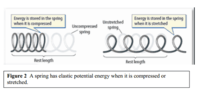
What equation is used to calculate elastic potential energy?
Ep = m g h
Ep = 1/2 k x2
Ep = F / E d
5.
MULTIPLE CHOICE QUESTION
1 min • 1 pt
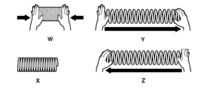
Elastic potential energy is energy stored in an object, such as a spring, due to the object being stretched or compressed. In which position is it most likely that the spring has lost its elastic potential energy?
W
Y
X
Z
Tags
NGSS.MS-PS3-2
6.
MULTIPLE CHOICE QUESTION
1 min • 1 pt

What type of energy is the girl storing in the bow?
Light Energy
Elastic Potential Energy
Chemical Potential Energy
Thermal Energy
Tags
NGSS.MS-PS3-2
7.
MULTIPLE CHOICE QUESTION
1 min • 1 pt

When an archer fires an arrow from a traditional bow, the string of the bow does not change length. As shown in the diagram, the archer pulls back on the string (Step 1), changing the curve of the bow (Step 2). When the archer releases the string, the bow returns to its original shape (Step 3). How does the elastic potential energy in the bow change as the archer fires an arrow?
It decreases from Step 1 to Step 2, then increases to Step 3.
It increases from Step 1 to Step 2, then decreases to Step 3.
It remains constant from Step 1 to Step 2, then increases to Step 3.
It remains constant from Step 1 to Step 2, then decreases to Step 3.
Answer explanation

Elastic potential energy in an object changes as a result of bending, compressing or changing the shape of the object. The archer adds potential energy to the bow by pulling on the string and changing the bow’s shape. When the archer releases the string, the bow resumes its original shape, losing the added potential energy.
Tags
NGSS.MS-PS3-2
NGSS.MS-PS3-5


Access all questions and much more by creating a free account
Create resources
Host any resource
Get auto-graded reports

Continue with Google

Continue with Email

Continue with Microsoft
or continue with

%20(1).png)
Apple

Others
Already have an account?

