
Selective Breeding and Natural Selection
Authored by Lisa Thompson
Science
7th Grade
NGSS covered
Used 1+ times


AI Actions
Add similar questions
Adjust reading levels
Convert to real-world scenario
Translate activity
More...
Content View
Student View
15 questions
Show all answers
1.
MULTIPLE CHOICE QUESTION
1 min • 1 pt
When nature "selects" a variation, that means that the trait:
Gets passed along from generation to generation
Causes the population to shrink
Has brought about a new species
Helps prey escape predators
Tags
NGSS.MS-LS4-4
2.
MULTIPLE CHOICE QUESTION
1 min • 1 pt
Which is an example of selective breeding?
A giraffe's long neck to get more food from tall trees
Clipping a horse's tail so it's not too long.
Training a horse to run faster in a race.
Cross breeding a labrador retriever with a poodle to get a service dog that is hypoallergenic.
3.
MULTIPLE CHOICE QUESTION
1 min • 1 pt
An example of selective breeding is
a dog breeder mating 2 dogs to make more dogs
a person pollinates 2 white rose plants to only create white roses
a farmer grows bees to pollinate the plants on his farm
Tags
NGSS.MS-LS4-4
NGSS.MS-LS3-2
4.
MULTIPLE CHOICE QUESTION
1 min • 1 pt
What selective breeding food crops might a farmer select?
plant produces the least amount of grain
plant was the most disease resistant
the plant was the smelliest plant
Tags
NGSS.MS-LS4-4
NGSS.MS-LS1-5
5.
MULTIPLE CHOICE QUESTION
1 min • 1 pt
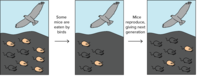
Why is the mouse population changing over time?
The light mice can reproduce more successfully than the dark mice
The hawks eat more dark mice than light mice because the dark mice taste better
The hawks eat more light mice because they can see the light mice more easily, so the dark live longer and reproduce more.
The hawks eat more dark mice than light mice because they can see the dark mice more easily
Tags
NGSS.MS-LS4-4
NGSS.MS-LS2-4
6.
MULTIPLE CHOICE QUESTION
1 min • 1 pt

What process is being shown in this image?
Variation
Natural Selection
Selective Breeding
Homeostasis
Tags
NGSS.MS-LS4-4
7.
MULTIPLE CHOICE QUESTION
1 min • 1 pt

Who was the Scientist most famous for his study of natural selection and evolution?
Theodor Schwann
Robert Hooke
Charles Darwin
Rudolf Virchow
Tags
NGSS.MS-LS4-4
NGSS.MS-LS4-1
NGSS.MS-LS4-2
Access all questions and much more by creating a free account
Create resources
Host any resource
Get auto-graded reports

Continue with Google

Continue with Email

Continue with Microsoft
or continue with

%20(1).png)
Apple

Others
Already have an account?



