
Dynamic Equilibrium
Authored by Lisa Thompson
Science
11th Grade
NGSS covered
Used 1+ times


AI Actions
Add similar questions
Adjust reading levels
Convert to real-world scenario
Translate activity
More...
Content View
Student View
25 questions
Show all answers
1.
MULTIPLE CHOICE QUESTION
1 min • 1 pt
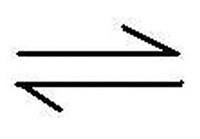
This symbol indicates that a reaction is ____________
reversible
irreversible
2.
MULTIPLE CHOICE QUESTION
1 min • 1 pt
Which of the following is incorrect?
A dynamic equilibrium can be achieved...
From 100% reactants
From 100% products
In a closed system
In an open system
Tags
NGSS.HS-PS1-5
3.
MULTIPLE CHOICE QUESTION
1 min • 1 pt
When the system A + B C + D is at dynamic equilibrium
the sum of the concentrations of A and B must equal the sum of the concentrations of C and D.
,the forward reaction has stopped.
both the forward and the reverse reactions have stopped.
the reverse reaction has stopped
neither the forward nor the reverse reaction has stopped.
4.
MULTIPLE CHOICE QUESTION
1 min • 1 pt

Around what time does the reaction reach equilibrium?
25 min
45 min
70 min
80 min
Tags
NGSS.HS-PS1-6
5.
MULTIPLE CHOICE QUESTION
1 min • 1 pt
Which of the following statements correctly describes any chemical reaction that has reached equilibrium?
The reaction is now irreversible.
The rates of the forward and reverse reactions are equal.
Both forward and reverse reactions have halted.
The concentrations of products and reactants are equal.
Tags
NGSS.HS-PS1-6
6.
MULTIPLE CHOICE QUESTION
1 min • 1 pt
What are the two factors to look for when determining if the reaction is at equilibrium?
Forward reaction rate is faster than the reverse and concentrations are equal
Forward and reverse reaction rates are equal and concentration is constant
Forward and revers reaction rates are equal and concentration is equal
Forward reaction rate is faster than the reverse and concentration is equal
Tags
NGSS.HS-PS1-6
7.
MULTIPLE CHOICE QUESTION
1 min • 1 pt
Why is equilibrium called a dynamic state?
Chemists try to convert as much reactants as possible into products.
The reactions at equilibrium continue to take place once equilibrium is established.
The products of a forward reaction are favored, so equilibrium lies to the right.
All chemical reactions are considered to be reversible under suitable conditions.
Access all questions and much more by creating a free account
Create resources
Host any resource
Get auto-graded reports

Continue with Google

Continue with Email

Continue with Classlink

Continue with Clever
or continue with

Microsoft
%20(1).png)
Apple

Others
Already have an account?


