
Population Ecology Graphs and Carrying Capacity
12th Grade
•15 Qs

Similar activities
Mechanisms of Evolution
11th - 12th Grade
•10 Qs
Client Status Review
9th - 12th Grade
•20 Qs
MIDTERMS REVIEW IN GEN. PHYSICS 1
12th Grade
•15 Qs
EXPLANATION 2
11th Grade - University
•15 Qs
Hormonal control of the menstrual cycle
7th - 12th Grade
•15 Qs
Revision - What Is A Cell?
11th - 12th Grade
•15 Qs
LESSON 2 QUIZ
6th Grade - University
•10 Qs
VARIASI SN T4
1st - 12th Grade
•10 Qs
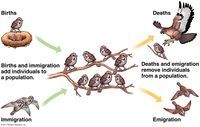
Population Ecology Graphs and Carrying Capacity

Quiz
•
Science
•
12th Grade
•
Practice Problem
•
Medium
+2
Standards-aligned

Lisa Thompson
Used 1+ times
FREE Resource

Enhance your content in a minute
15 questions
Show all answers
1.
MULTIPLE CHOICE QUESTION
1 min • 1 pt
A population is...
All members of one species in one area
All members of all species that live in one area
All of the living and nonliving things in an area
None of these
2.
MULTIPLE CHOICE QUESTION
1 min • 1 pt
Which factor is a density-dependent limiting factor on the population of a species?
seasonal variation
natural disasters
unusual weather
predation
Tags
NGSS.MS-LS2-4
3.
MULTIPLE CHOICE QUESTION
1 min • 1 pt
Population increases at a constant rate over time.
Exponential Growth
Logistic Growth
Stable Growth
Strategic Growth
Tags
NGSS.HS-LS4-2
4.
MULTIPLE CHOICE QUESTION
1 min • 1 pt
A graph that shows the number or proportion of individuals surviving to each age for a given species or group.
survivorship curve
exponential
linear
logistic
5.
MULTIPLE CHOICE QUESTION
1 min • 1 pt

Tracks organisms that tend to live long lives (low death rate and high survivorship rate); toward the end of their life expectancies, however, there is a dramatic increase in the death rate.
Type I
Type II
Type III
Type IV
Tags
NGSS.HS-LS2-2
6.
MULTIPLE CHOICE QUESTION
1 min • 1 pt
Describes organisms with a high death rate (or low survivorship rate) immediately following birth. Examples include bacteria, fishes, and invertebrates.
Type I
Type II
Type III
Type IV
7.
MULTIPLE CHOICE QUESTION
1 min • 1 pt
These organisms occupy stable environments, are larger in size and have longer life expectancies. They produce, during their life spans, fewer offspring, but place a greater investment in each.
k-strategist
r-strategist
m-strategist
s-strategist


Access all questions and much more by creating a free account
Create resources
Host any resource
Get auto-graded reports

Continue with Google

Continue with Email

Continue with Classlink

Continue with Clever
or continue with

Microsoft
%20(1).png)
Apple

Others
Already have an account?
Similar Resources on Wayground
10 questions
APES Unit 9: Global Change (JDAG)
Quiz
•
11th - 12th Grade
14 questions
Growth cycle and skin diagram
Quiz
•
12th Grade
15 questions
Pre-Test Physical Science
Quiz
•
11th - 12th Grade
10 questions
ชีววิทยา
Quiz
•
12th Grade - Professi...
10 questions
Biotic and abiotic factors
Quiz
•
6th Grade - University
20 questions
Climate Change - Quiz
Quiz
•
6th Grade - University
20 questions
3rd Summative Examination in Physical Science 11
Quiz
•
12th Grade
10 questions
Enzymes & Chemical Reactions
Quiz
•
9th - 12th Grade
Popular Resources on Wayground
15 questions
Fractions on a Number Line
Quiz
•
3rd Grade
20 questions
Equivalent Fractions
Quiz
•
3rd Grade
25 questions
Multiplication Facts
Quiz
•
5th Grade
54 questions
Analyzing Line Graphs & Tables
Quiz
•
4th Grade
22 questions
fractions
Quiz
•
3rd Grade
20 questions
Main Idea and Details
Quiz
•
5th Grade
20 questions
Context Clues
Quiz
•
6th Grade
15 questions
Equivalent Fractions
Quiz
•
4th Grade
Discover more resources for Science
89 questions
Unit 1 (Ch 2 & 3) Test Review - Water/Ocean Currents
Quiz
•
9th - 12th Grade
10 questions
Natural Resources

Lesson
•
9th - 12th Grade
12 questions
Comparing Mitosis and Meiosis
Lesson
•
9th - 12th Grade
10 questions
Symbiotic Relationships
Lesson
•
9th - 12th Grade
5 questions
Unit 3 AB Check
Quiz
•
9th - 12th Grade
9 questions
Identify Phases and Structures of Mitosis
Quiz
•
9th - 12th Grade
15 questions
Solar System
Lesson
•
9th - 12th Grade
16 questions
Identify Types of Rocks
Quiz
•
9th - 12th Grade