
Common Ancestry Review
Authored by Lisa Thompson
Science
8th Grade
NGSS covered
Used 1+ times


AI Actions
Add similar questions
Adjust reading levels
Convert to real-world scenario
Translate activity
More...
Content View
Student View
15 questions
Show all answers
1.
MULTIPLE CHOICE QUESTION
1 min • 1 pt
structure that evolved from a common ancestor
embryo
vestigial structure
homologous structure
fossil
Tags
NGSS.MS-LS4-2
2.
MULTIPLE CHOICE QUESTION
1 min • 1 pt
What is the significance of identifying vestigial structures in the embryos of different animals?
It demonstrates that embryos are fully developed at birth.
It suggests that embryos of various animals share a common evolutionary history.
It supports the idea that embryos of different species have identical structures.
It proves that all embryos have the same function.
Tags
NGSS.MS-LS4-2
NGSS.MS-LS4-3
3.
MULTIPLE CHOICE QUESTION
1 min • 1 pt
Which human anatomical structures are homologous to the wings of a bat, and what evidence supports this homology?
Human arms because they both have the same structure.
Human hair because they both have the same texture.
Human feet because they are both used for movement.
Human legs because they have the same bone features.
Tags
NGSS.MS-LS4-2
4.
MULTIPLE CHOICE QUESTION
1 min • 1 pt
structure that serves limited or no function
embryo
vestigial structure
homologous structure
fossil
5.
MULTIPLE CHOICE QUESTION
1 min • 1 pt

The study of the similarities and differences of body structures of different species
comparative embryology
comparative anatomy
evolution
fossil evidence
Tags
NGSS.MS-LS4-2
6.
MULTIPLE CHOICE QUESTION
1 min • 1 pt
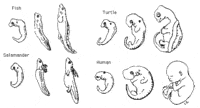
Study of embryos of various organisms to show a common ancestor because of similarities in development
natural selection
embryology
speciation
evolution
Tags
NGSS.MS-LS4-3
7.
MULTIPLE CHOICE QUESTION
1 min • 1 pt

The presence of pelvic bones in the baleen whale is evidence of which of the following?
Whales can travel on land when necessary.
Whales are developing into animals with four functioning limbs.
Whales have functional legs that are hidden by fat and skin.
Whales evolved from four-legged animals.
Tags
NGSS.MS-LS4-2
NGSS.MS-LS4-1
Access all questions and much more by creating a free account
Create resources
Host any resource
Get auto-graded reports

Continue with Google

Continue with Email

Continue with Microsoft
or continue with

%20(1).png)
Apple

Others
By signing up, you agree to our Terms of Service & Privacy Policy
Already have an account?


