
Covalent vs Ionic Bonds
8th Grade
•15 Qs

Similar activities
Unit 2 Test Review Non Renewable Resources
11th - 12th Grade
•20 Qs
Variables Reinforced
7th - 8th Grade
•15 Qs
SEDASEED 2020 - Wind and Kinetics
6th - 12th Grade
•20 Qs
SDG Intro Test
12th Grade
•10 Qs
Stem Cells Grade 9 quiz
9th - 10th Grade
•11 Qs
Projectile Motion Pre Test
7th - 10th Grade
•10 Qs
Module 5 Review
8th Grade
•10 Qs
Lab safety
9th - 12th Grade
•15 Qs
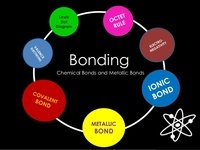
Covalent vs Ionic Bonds

Quiz
•
Science
•
8th Grade
•
Practice Problem
•
Hard
+3
Standards-aligned

Lisa Thompson
FREE Resource

Enhance your content in a minute
15 questions
Show all answers
1.
MULTIPLE CHOICE QUESTION
1 min • 1 pt
Polar covalent bonds form slight electrical charges because...
some elements pull more strongly on shared electrons
some elements are electrically charged by ions
some elements are electrically charged by nuclear forces
some elements are electrically charged by metals
Tags
NGSS.HS-PS2-4
2.
MULTIPLE CHOICE QUESTION
1 min • 1 pt
Why do elements covalently bond?
So they can share electrons, and fill both of their valence shells at the same time. They can then become stable.
So they can receive and gain electrons and become stable
So they can share electrons, and fill both of their valence shells at the same time. They can then become unstable.
So they can share electrons, and fill both of their valence shells at the same time. They can then form isotopes.
Tags
NGSS.HS-PS1-1
3.
MULTIPLE CHOICE QUESTION
1 min • 1 pt
Which of the following can form covalent bonds? Choose the best answer
Metals
Nonmetals
Both Metals and nonmetals
Only nuclear compounds.
Tags
NGSS.HS-PS1-1
4.
MULTIPLE CHOICE QUESTION
1 min • 1 pt
Atoms joined by covalent bonds form?
Atoms
Elements
Molecules
Ionic compounds
Tags
NGSS.MS-PS1-1
5.
MULTIPLE CHOICE QUESTION
1 min • 1 pt

Oxygen shares two pairs of electrons. It forms a __________ covalent bond
Single
Double
Triple
Quadruple
Tags
NGSS.HS-PS1-1
6.
MULTIPLE CHOICE QUESTION
1 min • 5 pts

What type of bonding does this picture show?
Ionic
Covalent
Tags
NGSS.HS-PS1-1
7.
MULTIPLE CHOICE QUESTION
1 min • 1 pt

When electrons are lost by one atom and gained by another, so that they both get full outer shells.
Covalent bond
Ionic bond
Pairing
Compound
Tags
NGSS.MS-PS1-5

Access all questions and much more by creating a free account
Create resources
Host any resource
Get auto-graded reports

Continue with Google

Continue with Email

Continue with Classlink

Continue with Clever
or continue with

Microsoft
%20(1).png)
Apple

Others
Already have an account?
Similar Resources on Wayground
15 questions
Forensics Death
Quiz
•
12th Grade - University
15 questions
AWS ACF Módulo 2 - Economia e Faturamento na Nuvem
Quiz
•
University
10 questions
Earthquake
Quiz
•
12th Grade
10 questions
SDG Intro Test
Quiz
•
12th Grade
15 questions
Y9 chemistry quiz on air and water
Quiz
•
7th - 10th Grade
15 questions
Earth and Earth System
Quiz
•
11th Grade
13 questions
Atomic Structure
Quiz
•
7th Grade - University
10 questions
Honey Bees
Quiz
•
9th - 12th Grade
Popular Resources on Wayground
15 questions
Fractions on a Number Line
Quiz
•
3rd Grade
20 questions
Equivalent Fractions
Quiz
•
3rd Grade
25 questions
Multiplication Facts
Quiz
•
5th Grade
22 questions
fractions
Quiz
•
3rd Grade
20 questions
Main Idea and Details
Quiz
•
5th Grade
20 questions
Context Clues
Quiz
•
6th Grade
15 questions
Equivalent Fractions
Quiz
•
4th Grade
20 questions
Figurative Language Review
Quiz
•
6th Grade
Discover more resources for Science
33 questions
Grade 6 Quarter 3 PMA 5 Review
Quiz
•
6th - 8th Grade
85 questions
Midpoint D1 Review
Quiz
•
8th Grade
12 questions
Newton's Laws of Motion

Lesson
•
6th - 8th Grade
10 questions
Exploring the Rock Cycle: Types and Formation

Interactive video
•
6th - 8th Grade
10 questions
Exploring the Layers of the Earth
Interactive video
•
6th - 10th Grade
20 questions
Pure Substances & Mixtures
Quiz
•
8th Grade
28 questions
Genes and Heredity
Lesson
•
8th Grade
24 questions
Subatomic Particles
Quiz
•
8th Grade