
Week 3 (5th Grade)
Authored by Kimberly Johnson
Education
5th Grade
CCSS covered
Used 2+ times


AI Actions
Add similar questions
Adjust reading levels
Convert to real-world scenario
Translate activity
More...
Content View
Student View
10 questions
Show all answers
1.
MULTIPLE CHOICE QUESTION
2 mins • 1 pt
Deposition of sediments can change the depth of a lake over time. A student wants to make a model that shows how this process takes place.
Which model would provide data about changes in the depth of a lake caused by deposition?
Fill a beaker with water. Slowly allow the water to evaporate from the beaker. Measure the change in the depth of the water.
Fill a beaker with water. Slowly drop sand, gravel, and dead plant material into the beaker. Measure the change in the depth of the water.
Fill a plastic box with water. Put a hose in the water on one end of the box and turn the water on to a slow flow. Measure the depth of the water when the box is full.
Fill a plastic box with sand, gravel, and dead plant mat
2.
MULTIPLE CHOICE QUESTION
2 mins • 1 pt

Which sentence describes how the differences between a plant cell and an animal cell can be determined by looking at the parts inside the cell?
Plant cells have a nucleus, but animal cells do not.
Plant cells have chloroplasts, but animal cells do not.
Plant cells do not have a nucleus, but animal cells do.
Plant cells do not have chloroplasts, but animal cells do.
3.
MULTIPLE CHOICE QUESTION
2 mins • 1 pt

Which argument BEST supports the student’s claim?
Ice forms because heat is added, causing the particles to move faster. This makes the ice flow.
Ice forms because heat is removed, causing the particles to move slower. This makes the ice change its shape.
Ice forms because heat is removed, causing the particles to move slower. This changes the water from a liquid to a solid.
Ice forms because heat is added, causing the particles to move faster. This changes the color of the water from clear to white.
4.
MULTIPLE SELECT QUESTION
3 mins • 1 pt
Students are investigating chemical changes that occur in different materials.
Which TWO investigations would provide evidence of a chemical change?
Placing a liquid in a freezer until the liquid becomes a solid would provide evidence of a chemical change because the state of matter changes
Using a saw to cut a solid into two different pieces would provide evidence of a chemical change because the pieces cannot be put back together
Using a hot plate to heat a solid until it changes color and releases an odor would provide evidence of a chemical change because the particles cannot be changed back
Placing two different liquids together in a beaker and observing that a solid forms when they mix would provide evidence of a chemical change because a new material is formed
Placing a mixture containing a solid and a liquid on a windowsill and letting the liquid evaporate would provide evidence of a chemical change because the evaporated material is lost
5.
MULTIPLE CHOICE QUESTION
2 mins • 1 pt

Which question can be asked to find out which characteristic is a learned behavior?
Do all eastern box turtles like the same food?
Do eastern box turtles in other states live for 50 years?
Do eastern box turtles in other states have the same color of spots?
Do all eastern box turtles hide in their shells when they are frightened?
6.
MULTIPLE CHOICE QUESTION
1 min • 1 pt
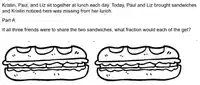
If all three friends were to share the two sandwiches, what fraction would each of them get?
3
2
Tags
CCSS.5.NF.B.3
7.
MULTIPLE CHOICE QUESTION
3 mins • 2 pts
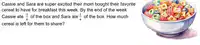
How much cereal is left for them to share?
5/8
3/8
Tags
CCSS.5.NF.A.1
CCSS.5.NF.A.2
Access all questions and much more by creating a free account
Create resources
Host any resource
Get auto-graded reports

Continue with Google

Continue with Email

Continue with Classlink

Continue with Clever
or continue with

Microsoft
%20(1).png)
Apple

Others
Already have an account?


