
KMT and Gases
Authored by Peggy Wessman
Chemistry
10th Grade
NGSS covered
Used 4+ times


AI Actions
Add similar questions
Adjust reading levels
Convert to real-world scenario
Translate activity
More...
Content View
Student View
16 questions
Show all answers
1.
MULTIPLE CHOICE QUESTION
1 min • 1 pt

As Nick inflates a balloon and its volume increases, the pressure inside the balloon will
decrease.
remain the same.
increase.
I don’t know
2.
MULTIPLE CHOICE QUESTION
1 min • 1 pt
Evan is conducting an experiment in her science class. She wants to know which is a measure of the amount of particle collisions against the walls of the container?
pressure
temperature
volume
density
3.
MULTIPLE CHOICE QUESTION
1 min • 1 pt

During a science experiment, Karen observes the behavior of an ideal gas in a sealed container. Which statement must be true of the gas?
Gas particles are elastic and do not attract each other.
The kinetic energy of gas is dependent on temperature
Energy is not lost when gas particles collide with each other or with the walls of the container.
All of the above
Tags
NGSS.HS-PS3-2
NGSS.HS-PS3-1
4.
MULTIPLE CHOICE QUESTION
1 min • 1 pt
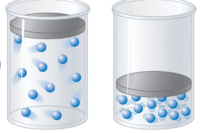
Tony and Dominick are conducting an experiment with two containers. Which container will have a lower pressure?
left
right
they both have the same pressure
I don't know
5.
MULTIPLE CHOICE QUESTION
45 sec • 1 pt
Which of the following is an assumption of the kinetic-molecular theory of gases?
Collisions between gas particles are inelastic.
Gases consist of closely spaced particles.
Gas particles move around in an orderly manner.
The temperature of a gas depends on the average kinetic energy of the gas particles.
Tags
NGSS.HS-PS3-2
6.
MULTIPLE CHOICE QUESTION
45 sec • 1 pt
Which of the following is the equation needed to calculate the kinetic energy, KE, of a moving particle?
KE = 1/2 mv2
KE = 2mv
KE = mv
KE = 1/2 m2v
7.
MULTIPLE CHOICE QUESTION
45 sec • 1 pt
Assume each sample of gas molecules has the same average velocity. Which sample of gas has the highest kinetic energy?
O2
H2O
H2
Xe
Access all questions and much more by creating a free account
Create resources
Host any resource
Get auto-graded reports

Continue with Google

Continue with Email

Continue with Classlink

Continue with Clever
or continue with

Microsoft
%20(1).png)
Apple

Others
Already have an account?


