
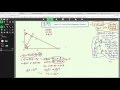
Understanding Similar Triangles and the Pythagorean Theorem

Interactive Video
•
Mathematics
•
9th - 10th Grade
•
Practice Problem
•
Hard

Thomas White
FREE Resource
Read more
10 questions
Show all answers
1.
MULTIPLE CHOICE QUESTION
30 sec • 1 pt
What is the main focus of the lesson in this video?
Proof of the Pythagorean theorem using similar triangles
Introduction to algebra
History of mathematics
Basic geometry concepts
2.
MULTIPLE CHOICE QUESTION
30 sec • 1 pt
What is the first step in proving the Pythagorean theorem using similar triangles?
Using trigonometric identities
Applying the law of sines
Building two sub-triangles and showing their similarity
Calculating angles
3.
MULTIPLE CHOICE QUESTION
30 sec • 1 pt
How do we establish the similarity between the sub-triangles and the original triangle?
By measuring their sides
By using the angle-angle similarity criterion
By comparing their perimeters
By calculating their areas
4.
MULTIPLE CHOICE QUESTION
30 sec • 1 pt
What algebraic property is used to combine the equations derived from the similar triangles?
Additive property of equality
Commutative property
Multiplicative property of equality
Distributive property
5.
MULTIPLE CHOICE QUESTION
30 sec • 1 pt
What is the final result of the proof using similar triangles and algebra?
a^2 + b^2 = c^2
a^2 + b^2 = 2c^2
a^2 - b^2 = c^2
a^2 = b^2 + c^2
6.
MULTIPLE CHOICE QUESTION
30 sec • 1 pt
In the application problem, what is the first step to find the length of side DC?
Calculate the area
Use the sine rule
Apply the Pythagorean theorem
Measure the angle
7.
MULTIPLE CHOICE QUESTION
30 sec • 1 pt
What is the length of side DC if side AB is 13 and side AC is 12?
8
15
10
5
Access all questions and much more by creating a free account
Create resources
Host any resource
Get auto-graded reports

Continue with Google

Continue with Email

Continue with Classlink

Continue with Clever
or continue with

Microsoft
%20(1).png)
Apple

Others
Already have an account?

