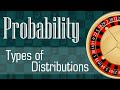
Understanding Probability Distributions

Interactive Video
•
Mathematics
•
10th - 12th Grade
•
Practice Problem
•
Hard
Thomas White
FREE Resource
Read more
10 questions
Show all answers
1.
MULTIPLE CHOICE QUESTION
30 sec • 1 pt
What is the main difference between discrete and continuous probability distributions?
Discrete distributions are used for hypothesis testing, while continuous distributions are not.
Continuous distributions are always symmetric, while discrete distributions are not.
Discrete distributions are used for time-related events, while continuous distributions are not.
Discrete distributions have a finite number of outcomes, while continuous distributions have infinitely many.
2.
MULTIPLE CHOICE QUESTION
30 sec • 1 pt
Which distribution is used for events with two possible outcomes, such as true or false?
Normal Distribution
Uniform Distribution
Bernoulli Distribution
Poisson Distribution
3.
MULTIPLE CHOICE QUESTION
30 sec • 1 pt
What type of distribution is used when conducting multiple iterations of a Bernoulli event?
Chi-Squared Distribution
Poisson Distribution
Binomial Distribution
Exponential Distribution
4.
MULTIPLE CHOICE QUESTION
30 sec • 1 pt
Which distribution is suitable for modeling the frequency of rare events over a fixed interval?
Normal Distribution
Binomial Distribution
Poisson Distribution
Logistic Distribution
5.
MULTIPLE CHOICE QUESTION
30 sec • 1 pt
What is a key characteristic of the Normal distribution?
It is always skewed to the left.
It has a bell-shaped curve.
It is used for rapidly changing events.
It only consists of non-negative values.
6.
MULTIPLE CHOICE QUESTION
30 sec • 1 pt
When is the Student's-T distribution used instead of the Normal distribution?
When the data only contains non-negative values.
When dealing with large sample sizes.
When the data is skewed to the right.
When the sample size is small.
7.
MULTIPLE CHOICE QUESTION
30 sec • 1 pt
What is a unique feature of the Chi-Squared distribution?
It is used for events with two outcomes.
It is used for rapidly changing events.
It is symmetric and bell-shaped.
It only consists of non-negative values.
Access all questions and much more by creating a free account
Create resources
Host any resource
Get auto-graded reports

Continue with Google

Continue with Email

Continue with Classlink

Continue with Clever
or continue with

Microsoft
%20(1).png)
Apple

Others
Already have an account?
Popular Resources on Wayground

15 questions
Fractions on a Number Line

Quiz
•
3rd Grade
20 questions
Equivalent Fractions
Quiz
•
3rd Grade
25 questions
Multiplication Facts
Quiz
•
5th Grade
54 questions
Analyzing Line Graphs & Tables
Quiz
•
4th Grade
22 questions
fractions
Quiz
•
3rd Grade
20 questions
Main Idea and Details
Quiz
•
5th Grade
20 questions
Context Clues
Quiz
•
6th Grade
15 questions
Equivalent Fractions
Quiz
•
4th Grade
Discover more resources for Mathematics
18 questions
SAT Prep: Ratios, Proportions, & Percents
Quiz
•
9th - 10th Grade
12 questions
Parallel Lines Cut by a Transversal
Quiz
•
10th Grade
12 questions
Add and Subtract Polynomials
Quiz
•
9th - 12th Grade
10 questions
Elijah McCoy: Innovations and Impact in Black History
Interactive video
•
6th - 10th Grade
16 questions
Converting Improper Fractions to Mixed Numbers
Quiz
•
4th - 10th Grade
15 questions
Intro to Trig Ratios
Quiz
•
10th Grade
10 questions
Solving One Step Equations: Key Concepts and Techniques
Interactive video
•
6th - 10th Grade
12 questions
Triangle Inequality Theorem
Quiz
•
10th Grade