
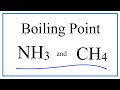
Polarity and Boiling Points of Molecules

Interactive Video
•
Chemistry
•
9th - 10th Grade
•
Practice Problem
•
Hard

Sophia Harris
FREE Resource
Read more
10 questions
Show all answers
1.
MULTIPLE CHOICE QUESTION
30 sec • 1 pt
What is the primary reason that molar mass is not a significant factor in the boiling points of ammonia and methane?
They have different chemical properties.
They have similar molar masses.
They have different molecular structures.
They are both gases at room temperature.
2.
MULTIPLE CHOICE QUESTION
30 sec • 1 pt
Why is methane considered a non-polar molecule?
It has a lone pair of electrons.
It forms hydrogen bonds.
It has a high electronegativity difference.
It has a symmetrical shape that cancels out dipoles.
3.
MULTIPLE CHOICE QUESTION
30 sec • 1 pt
What type of intermolecular force is primarily responsible for the attraction between methane molecules?
Ionic bonding
London dispersion forces
Dipole-dipole interactions
Hydrogen bonding
4.
MULTIPLE CHOICE QUESTION
30 sec • 1 pt
What structural feature of ammonia contributes to its polar nature?
Equal distribution of charge
Presence of a lone pair of electrons
Symmetrical shape
Non-polar bonds
5.
MULTIPLE CHOICE QUESTION
30 sec • 1 pt
How does the polarity of ammonia affect its boiling point compared to methane?
It makes the boiling point equal to methane.
It raises the boiling point.
It has no effect on the boiling point.
It lowers the boiling point.
6.
MULTIPLE CHOICE QUESTION
30 sec • 1 pt
What type of bonding is present in ammonia that is not in methane?
Metallic bonding
Ionic bonding
Hydrogen bonding
Covalent bonding
7.
MULTIPLE CHOICE QUESTION
30 sec • 1 pt
What is the boiling point of ammonia in degrees Celsius?
-161.6
100
0
-33.3
Access all questions and much more by creating a free account
Create resources
Host any resource
Get auto-graded reports

Continue with Google

Continue with Email

Continue with Classlink

Continue with Clever
or continue with

Microsoft
%20(1).png)
Apple

Others
Already have an account?

